
Taming the Call Storm

Vincent Geffray

In today's digital world, it is possible to gauge the cost implications of an IT outage on employee productivity, revenue generation but it is usually much more tricky to measure the negative impacts on the very IT people's lives.

Think about this for a minute:

You're a financial advisor and you are meeting with this young couple who just got married 2 months ago. They want to purchase their first place and call it "home." They are interested in what your bank has to offer for mortgage … They only have an hour for you and you've already walked them through the different options and the associated costs.

At this point, you just need to collect a few more information about their income, their credit score and just run the numbers with the mortgage computer application. You log onto the mortgage portal, you see the spinning wheel in the middle of the screen but nothing happens. You try again, you may even apologize and reboot your computer. You try again and get the same damn wheel.

The friendly couple really needs to leave now as they must get back to work. And they do. Your day couldn't get any better, right?

Now what? You could open a ticket with Corporate IT, but you really want to make sure someone hears the story of what just happened. You want to share your feelings and talk to someone real. You are now calling the dedicated 1-800 line to IT Technical Support. What you don't know yet is that thousands of agents have experienced the exact same issue and want to share their frustration with the team they think is responsible for all this mess: IT. Because of the unplanned volumes of calls, you will most likely be placed on-hold and in queue before someone can actually answer your call. From a Service Desk perspective this is called a Call Storm! An unplanned influx of angry colleagues calling the IT Desk.
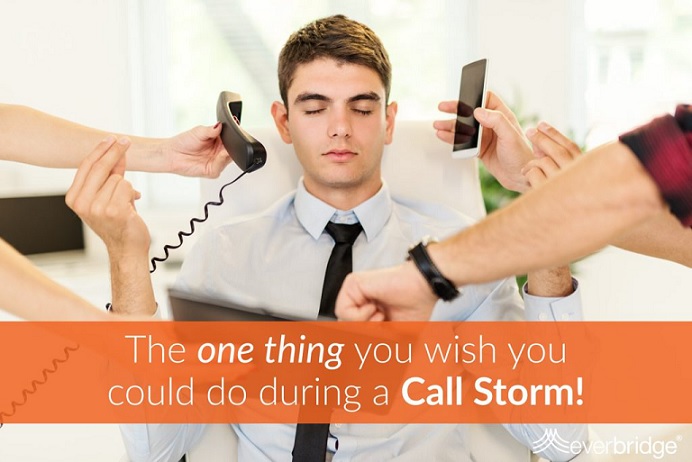

Now, put yourself in the service desk professional's shoes who will be taking your call … They have to answer hundreds of calls just like yours. They must remain nice and courteous. They usually need to apologize for the inconvenience like if they were responsible for this problem. On top of that, they may have to apologize for not being able to provide you with any update other than "Yes, we know the mortgage application is down. All our engineers are looking into the issue. Sorry, we actually don't know how long this will last"

Isn't it another great day in IT land?

What's going on? How long will this last? What are we doing about it? If you've ever had a major incident impact users throughout your organization, chances are you've heard those questions before. Your IT team may already be trying to diagnose and correct the issue, but the questions just keep coming …

Customers and end users just want to make sure IT is aware of the issue. But when hundreds — even thousands — try to contact the service desk, then you have a call storm. And the inability to properly weather it increases the urgency end users feel.

To reduce the volumes of inbound calls into the support center, IT Alerting solutions are designed to help expedite the IT response process and proactively communicated with impacted business users.

Hot Topics

The Latest

For decades, enterprise networks were designed around a simple assumption: work happened inside the office. Applications lived in centralized data centers, employees connected through internal infrastructure, and security focused on protecting the perimeter that surrounded everything ... But the way organizations operate today bears little resemblance to that environment. Cloud platforms host critical applications, employees connect from homes and airports as often as they do from offices, and partners collaborate through shared systems that exist far beyond corporate walls. In short, the corporate network no longer resembles the environment it was designed to protect ...

As an analyst who researches how IT organizations design, build, and operate their networks, I find that network data is a constant source of pain. Network teams struggle with data quality, fragmentation, authority, access, and trust. And these issues undermine everything they try to do. Here are the numbers: Only 45% of network teams are completely confident in the accuracy of their network source of truth, which documents the intent of their network ...

The 2026 Global Data Center Survey from Uptime Institute reveals an industry navigating workforce constraints, escalating outage expenses, even as rising costs remain the top concern for management teams ...

The next observability gap may not be in the code. It may be under the rack. That sounds strange until you think about how AI incidents actually feel in the middle of an investigation ... The application dashboard may be accurate. It may also be stopping at the wrong boundary. AI systems depend on software, but they also depend on a dense physical stack: racks, power paths, thermal margin, maintenance activity and, in many environments, liquid cooling. Those physical dependencies can change slowly before they look like a software incident ...

Certificate expiration is the rare outage you can see coming. Every TLS certificate carries the date it stops working, so the moment it will begin breaking connections is knowable in advance. That's what makes an expired certificate such a frustrating way to lose a service. What's changing now is how often that date comes around ...

Enterprises operate different combinations of workloads across cloud, hybrid and multicloud environments. For business-critical workloads, teams need to consider monitoring and observability early so they can detect health issues, investigate failures, and understand operational impact. Organizations place workloads on cloud platforms based on a combination of technical requirements, economics, existing dependencies, organizational standards, and business priorities. Their monitoring priorities therefore depend on what they operate and where those systems run. Those priorities will not look the same for every organization ...

Top-performing businesses prioritize data-driven decision making, enabling leaders to move from intuition and gut feel towards evidence-based judgment. But that judgment is only sound when the data underpinning decisions is accurate. With incident management, data accuracy is particularly important. Long-term revenue, customer trust, and operational stability depend on high-quality data that enables teams to quickly identify and address the root cause of major incidents. Against this backdrop, governance becomes a critical endeavor to ensure the right data drives the right action ...

In MEAN TIME TO INSIGHT Episode 26, Shamus McGillicuddy, VP of Research, Network Infrastructure and Operations, at EMA discusses network compliance ... 

Most production autonomous agents do not run in a vacuum. They run inside cloud infrastructure: virtual machines, containers, pods, managed clusters or private servers. That is where most operations teams start monitoring. Is the VM alive? Is the container running? Did the pod restart? Is memory stable? Is CPU too high? Did the health check pass? Those signals are useful. They tell you whether the shell around the agent is alive. They do not tell you whether the agent inside is actually operational ...

Enterprise IT environments have never been more observable ... Yet many organizations still grapple with outages, lengthy incident resolution cycles, and increasing complexity. Most teams do not suffer from a shortage of data. They struggle to determine what deserves attention and what action to take next ... Enterprise IT operations must move beyond monitoring and visibility. The next stage of maturity is decision operations, an approach that helps teams make faster, better-informed decisions ...

Taming the Call Storm

Vincent Geffray

In today's digital world, it is possible to gauge the cost implications of an IT outage on employee productivity, revenue generation but it is usually much more tricky to measure the negative impacts on the very IT people's lives.

Think about this for a minute:

You're a financial advisor and you are meeting with this young couple who just got married 2 months ago. They want to purchase their first place and call it "home." They are interested in what your bank has to offer for mortgage … They only have an hour for you and you've already walked them through the different options and the associated costs.

At this point, you just need to collect a few more information about their income, their credit score and just run the numbers with the mortgage computer application. You log onto the mortgage portal, you see the spinning wheel in the middle of the screen but nothing happens. You try again, you may even apologize and reboot your computer. You try again and get the same damn wheel.

The friendly couple really needs to leave now as they must get back to work. And they do. Your day couldn't get any better, right?

Now what? You could open a ticket with Corporate IT, but you really want to make sure someone hears the story of what just happened. You want to share your feelings and talk to someone real. You are now calling the dedicated 1-800 line to IT Technical Support. What you don't know yet is that thousands of agents have experienced the exact same issue and want to share their frustration with the team they think is responsible for all this mess: IT. Because of the unplanned volumes of calls, you will most likely be placed on-hold and in queue before someone can actually answer your call. From a Service Desk perspective this is called a Call Storm! An unplanned influx of angry colleagues calling the IT Desk.


Now, put yourself in the service desk professional's shoes who will be taking your call … They have to answer hundreds of calls just like yours. They must remain nice and courteous. They usually need to apologize for the inconvenience like if they were responsible for this problem. On top of that, they may have to apologize for not being able to provide you with any update other than "Yes, we know the mortgage application is down. All our engineers are looking into the issue. Sorry, we actually don't know how long this will last"

Isn't it another great day in IT land?

What's going on? How long will this last? What are we doing about it? If you've ever had a major incident impact users throughout your organization, chances are you've heard those questions before. Your IT team may already be trying to diagnose and correct the issue, but the questions just keep coming …

Customers and end users just want to make sure IT is aware of the issue. But when hundreds — even thousands — try to contact the service desk, then you have a call storm. And the inability to properly weather it increases the urgency end users feel.

To reduce the volumes of inbound calls into the support center, IT Alerting solutions are designed to help expedite the IT response process and proactively communicated with impacted business users.

Hot Topics

The Latest

For decades, enterprise networks were designed around a simple assumption: work happened inside the office. Applications lived in centralized data centers, employees connected through internal infrastructure, and security focused on protecting the perimeter that surrounded everything ... But the way organizations operate today bears little resemblance to that environment. Cloud platforms host critical applications, employees connect from homes and airports as often as they do from offices, and partners collaborate through shared systems that exist far beyond corporate walls. In short, the corporate network no longer resembles the environment it was designed to protect ...

As an analyst who researches how IT organizations design, build, and operate their networks, I find that network data is a constant source of pain. Network teams struggle with data quality, fragmentation, authority, access, and trust. And these issues undermine everything they try to do. Here are the numbers: Only 45% of network teams are completely confident in the accuracy of their network source of truth, which documents the intent of their network ...

The 2026 Global Data Center Survey from Uptime Institute reveals an industry navigating workforce constraints, escalating outage expenses, even as rising costs remain the top concern for management teams ...

The next observability gap may not be in the code. It may be under the rack. That sounds strange until you think about how AI incidents actually feel in the middle of an investigation ... The application dashboard may be accurate. It may also be stopping at the wrong boundary. AI systems depend on software, but they also depend on a dense physical stack: racks, power paths, thermal margin, maintenance activity and, in many environments, liquid cooling. Those physical dependencies can change slowly before they look like a software incident ...

Certificate expiration is the rare outage you can see coming. Every TLS certificate carries the date it stops working, so the moment it will begin breaking connections is knowable in advance. That's what makes an expired certificate such a frustrating way to lose a service. What's changing now is how often that date comes around ...

Enterprises operate different combinations of workloads across cloud, hybrid and multicloud environments. For business-critical workloads, teams need to consider monitoring and observability early so they can detect health issues, investigate failures, and understand operational impact. Organizations place workloads on cloud platforms based on a combination of technical requirements, economics, existing dependencies, organizational standards, and business priorities. Their monitoring priorities therefore depend on what they operate and where those systems run. Those priorities will not look the same for every organization ...

Top-performing businesses prioritize data-driven decision making, enabling leaders to move from intuition and gut feel towards evidence-based judgment. But that judgment is only sound when the data underpinning decisions is accurate. With incident management, data accuracy is particularly important. Long-term revenue, customer trust, and operational stability depend on high-quality data that enables teams to quickly identify and address the root cause of major incidents. Against this backdrop, governance becomes a critical endeavor to ensure the right data drives the right action ...

In MEAN TIME TO INSIGHT Episode 26, Shamus McGillicuddy, VP of Research, Network Infrastructure and Operations, at EMA discusses network compliance ... 

Most production autonomous agents do not run in a vacuum. They run inside cloud infrastructure: virtual machines, containers, pods, managed clusters or private servers. That is where most operations teams start monitoring. Is the VM alive? Is the container running? Did the pod restart? Is memory stable? Is CPU too high? Did the health check pass? Those signals are useful. They tell you whether the shell around the agent is alive. They do not tell you whether the agent inside is actually operational ...

Enterprise IT environments have never been more observable ... Yet many organizations still grapple with outages, lengthy incident resolution cycles, and increasing complexity. Most teams do not suffer from a shortage of data. They struggle to determine what deserves attention and what action to take next ... Enterprise IT operations must move beyond monitoring and visibility. The next stage of maturity is decision operations, an approach that helps teams make faster, better-informed decisions ...