

Internet Outages Cost Companies Upwards of $10 Million per Month

97% of companies assert a reliable, resilient Internet Stack is of utmost importance to their business success

Almost all (97%) of respondents state that a reliable, resilient Internet Stack is of the utmost importance to their business success, according to Catchpoint's inaugural Internet Resilience Report.

CEOs and company boards are prioritizing Internet resilience as a critical factor in maintaining and enhancing business operations. The Internet's complexity and its vital role in connecting businesses and customers necessitate a holistic resilience strategy. Companies rely on the Internet for connectivity and digital experiences, and outages can add up to many millions of dollars, making the need for Internet Resilience a board-level discussion. In 2024, any business, whether involved in eCommerce or operating with a distributed or remote workforce, must ensure strong Internet resilience.
Based on insights gathered from 310 digital business leaders, key findings from the new report revealed: 

■ 78% identify improved customer experience as the primary driver for resilience programs. 

■ 77% highlight the critical role of third-party technology providers in their Internet resilience strategies. 

■ 43% estimate a total economic impact or loss of more than $1 million monthly due to Internet outages or degradations and some Internet outages cost some companies upward of $10 million a month. 

■ 40% cite talent and skillset as a major barrier to implementing IPM. 

"Our findings highlight the criticality of Internet Resilience in our always-on, digital-first world," said Mehdi Daoudi, CEO of Catchpoint. "Businesses must expand their observability boundaries beyond Application Performance Monitoring to include Internet Performance Monitoring. This is the best way to proactively address issues impacting operations as it is the only way to get real-time insights and ensure superior performance that can reduce risks to both reputation and revenue."
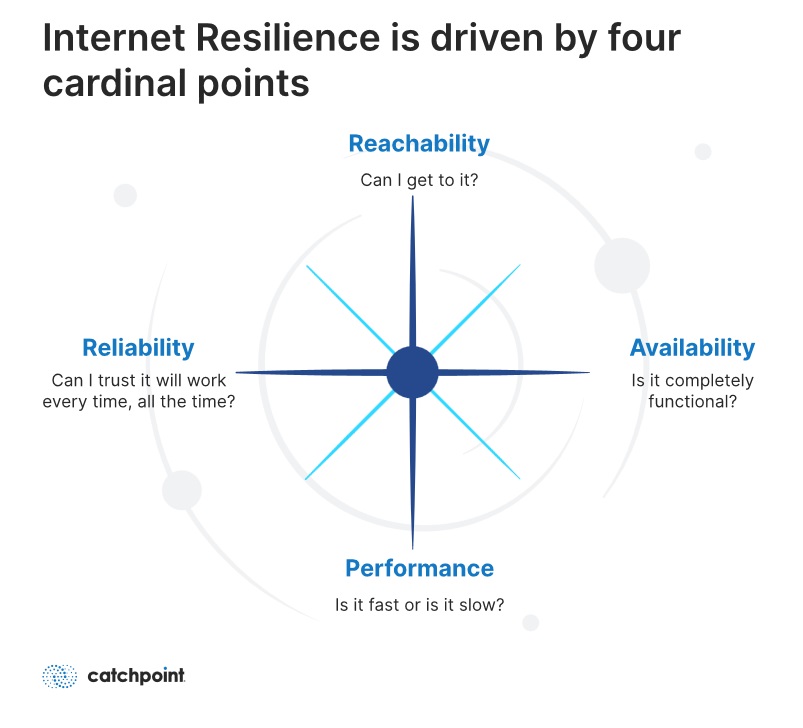
 

Catchpoint's report provides actionable insights for businesses to enhance their Internet Resilience, and their top suggestions include:

Think about Resilience from the Top Down

Leaders must incorporate Internet resilience into their strategic plans and daily operations to instill an effective, long-term culture of resilience. This includes the implementation of a new role, that of chief reliability or chief resilience officer to the C-suites, something Fortune 2000 companies are increasingly doing.

Align Internally

Break down organizational silos and foster collaboration between IT and business teams to ensure alignment and a focused, constructive response to outages.

Implement Internet Performance Monitoring

Utilize objective, independent IPM data to settle disputes and remove emotion from the equation, while setting Service Level Objectives (SLOs) to guide actions during incidents. The longer mean time to repair (MTTR) takes, the more the risk of payouts and other ramifications increases, including the threat of decreased customer loyalty — be sure to equip your ITOps team with the tools they need to continue to succeed. As the Internet continues to be an indispensable resource for businesses, ensuring its resilience is paramount. 

"Internet resilience should be a critical part of your overall Disaster Recovery / Business Continuity program," said Pete Charlton, IT Vice President, TMNAS. "Ultimately the CIO/CTO is accountable for the organization's digital resilience, but these are not just technology problems. Resilience and business continuity are in fact overall organizational issues that need to be discussed at the organization's highest levels and tested as frequently as possible. Obviously, you cannot simulate every possible outage, but if the past few years have taught us anything, it is that you need to plan for the unexpected."

The Latest

Many organizations describe AI as strategic, but they do not manage it strategically. When AI plans are disconnected from strategy, detached from organizational learning, and protected from serious assumptions testing, the problem is no longer technical immaturity; it is a failure of management discipline ... Executives too often tell organizations to "use AI" before they define what AI is supposed to change. The problem deepens in organizations where strategy isn't well articulated in the first place ...

Across the enterprise technology landscape, a quiet crisis is playing out. Organizations have run hundreds, sometimes thousands, of generative AI pilots. Leadership has celebrated the proof of concept (POCs) ... Industry experience points to a sobering reality: only 5-10% of AI POCs that progress to the pilot stage successfully reach scaled production. The remaining 90% fail because the enterprise environment around them was never ready to absorb them, not the AI models ...

Today's modern systems are not what they once were. Organizations now rely on distributed systems, event-driven workflows, hybrid and multi-cloud environments and continuous delivery pipelines. While each adds flexibility, it also introduces new, often invisible failures. Development speed is no longer the primary bottleneck of innovation. Reliability is ...

Seeing is believing, or in this case, seeing is understanding, according to New Relic's 2025 Observability Forecast for Retail and eCommerce report. Retailers who want to provide exceptional customer experiences while improving IT operations efficiency are leaning on observability ... Here are five key takeaways from the report ...

Technology leaders across the federal landscape are facing, and will continue to face, an uphill battle when it comes to fortifying their digital environments against hostile and persistent threat actors. On one hand, they are being asked to push digital transformation ... On the other hand, they are facing the fiscal uncertainty of continuing resolutions (CR) and government shutdowns looming near and far. In the face of these challenges, CIOs, CTOs, and CISOs must figure out how to modernize legacy systems and infrastructure while doing more with less and still defending against external and internal threats ...

Reliability is no longer proven by uptime alone, according to the The SRE Report 2026 from LogicMonitor. In the AI era, it is experienced through speed, consistency, and user trust, and increasingly judged by business impact. As digital services grow more complex and AI systems move into production, traditional monitoring approaches are struggling to keep pace, increasing the need for AI-first observability that spans applications, infrastructure, and the Internet ...

If AI is the engine of a modern organization, then data engineering is the road system beneath it. You can build the most powerful engine in the world, but without paved roads, traffic signals, and bridges that can support its weight, it will stall. In many enterprises, the engine is ready. The roads are not ...

In the world of digital-first business, there is no tolerance for service outages. Businesses know that outages are the quickest way to lose money and customers. For smaller organizations, unplanned downtime could even force the business to close ... A new study from PagerDuty, The State of AI-First Operations, reveals that companies actively incorporating AI into operations now view operational resilience as a growth driver rather than a cost center. But how are they achieving it? ...

In live financial environments, capital markets software cannot pause for rebuilds. New capabilities are introduced as stacked technology layers to meet evolving demands while systems remain active, data keeps moving, and controls stay intact. AI is no exception, and its opportunities are significant: accelerated decision cycles, compressed manual workflows, and more effective operations across complex environments. The constraint isn't the models themselves, but the architectural environments they enter ...

Like most digital transformation shifts, organizations often prioritize productivity and leave security and observability to keep pace. This usually translates to both the mass implementation of new technology and fragmented monitoring and observability (M&O) tooling. In the era of AI and varied cloud architecture, a disparate observability function can be dangerous. IT teams will lack a complete picture of their IT environment, making it harder to diagnose issues while slowing down mean time to resolve (MTTR). In fact, according to recent data from the SolarWinds State of Monitoring & Observability Report, 77% of IT personnel said the lack of visibility across their on-prem and cloud architecture was an issue ...

Internet Outages Cost Companies Upwards of $10 Million per Month

97% of companies assert a reliable, resilient Internet Stack is of utmost importance to their business success

Almost all (97%) of respondents state that a reliable, resilient Internet Stack is of the utmost importance to their business success, according to Catchpoint's inaugural Internet Resilience Report.

CEOs and company boards are prioritizing Internet resilience as a critical factor in maintaining and enhancing business operations. The Internet's complexity and its vital role in connecting businesses and customers necessitate a holistic resilience strategy. Companies rely on the Internet for connectivity and digital experiences, and outages can add up to many millions of dollars, making the need for Internet Resilience a board-level discussion. In 2024, any business, whether involved in eCommerce or operating with a distributed or remote workforce, must ensure strong Internet resilience.

Based on insights gathered from 310 digital business leaders, key findings from the new report revealed: 

■ 78% identify improved customer experience as the primary driver for resilience programs. 

■ 77% highlight the critical role of third-party technology providers in their Internet resilience strategies. 

■ 43% estimate a total economic impact or loss of more than $1 million monthly due to Internet outages or degradations and some Internet outages cost some companies upward of $10 million a month. 

■ 40% cite talent and skillset as a major barrier to implementing IPM. 

"Our findings highlight the criticality of Internet Resilience in our always-on, digital-first world," said Mehdi Daoudi, CEO of Catchpoint. "Businesses must expand their observability boundaries beyond Application Performance Monitoring to include Internet Performance Monitoring. This is the best way to proactively address issues impacting operations as it is the only way to get real-time insights and ensure superior performance that can reduce risks to both reputation and revenue."
 

Catchpoint's report provides actionable insights for businesses to enhance their Internet Resilience, and their top suggestions include:

Think about Resilience from the Top Down

Leaders must incorporate Internet resilience into their strategic plans and daily operations to instill an effective, long-term culture of resilience. This includes the implementation of a new role, that of chief reliability or chief resilience officer to the C-suites, something Fortune 2000 companies are increasingly doing.

Align Internally

Break down organizational silos and foster collaboration between IT and business teams to ensure alignment and a focused, constructive response to outages.

Implement Internet Performance Monitoring

Utilize objective, independent IPM data to settle disputes and remove emotion from the equation, while setting Service Level Objectives (SLOs) to guide actions during incidents. The longer mean time to repair (MTTR) takes, the more the risk of payouts and other ramifications increases, including the threat of decreased customer loyalty — be sure to equip your ITOps team with the tools they need to continue to succeed. As the Internet continues to be an indispensable resource for businesses, ensuring its resilience is paramount. 

"Internet resilience should be a critical part of your overall Disaster Recovery / Business Continuity program," said Pete Charlton, IT Vice President, TMNAS. "Ultimately the CIO/CTO is accountable for the organization's digital resilience, but these are not just technology problems. Resilience and business continuity are in fact overall organizational issues that need to be discussed at the organization's highest levels and tested as frequently as possible. Obviously, you cannot simulate every possible outage, but if the past few years have taught us anything, it is that you need to plan for the unexpected."

The Latest

Many organizations describe AI as strategic, but they do not manage it strategically. When AI plans are disconnected from strategy, detached from organizational learning, and protected from serious assumptions testing, the problem is no longer technical immaturity; it is a failure of management discipline ... Executives too often tell organizations to "use AI" before they define what AI is supposed to change. The problem deepens in organizations where strategy isn't well articulated in the first place ...

Across the enterprise technology landscape, a quiet crisis is playing out. Organizations have run hundreds, sometimes thousands, of generative AI pilots. Leadership has celebrated the proof of concept (POCs) ... Industry experience points to a sobering reality: only 5-10% of AI POCs that progress to the pilot stage successfully reach scaled production. The remaining 90% fail because the enterprise environment around them was never ready to absorb them, not the AI models ...

Today's modern systems are not what they once were. Organizations now rely on distributed systems, event-driven workflows, hybrid and multi-cloud environments and continuous delivery pipelines. While each adds flexibility, it also introduces new, often invisible failures. Development speed is no longer the primary bottleneck of innovation. Reliability is ...

Seeing is believing, or in this case, seeing is understanding, according to New Relic's 2025 Observability Forecast for Retail and eCommerce report. Retailers who want to provide exceptional customer experiences while improving IT operations efficiency are leaning on observability ... Here are five key takeaways from the report ...

Technology leaders across the federal landscape are facing, and will continue to face, an uphill battle when it comes to fortifying their digital environments against hostile and persistent threat actors. On one hand, they are being asked to push digital transformation ... On the other hand, they are facing the fiscal uncertainty of continuing resolutions (CR) and government shutdowns looming near and far. In the face of these challenges, CIOs, CTOs, and CISOs must figure out how to modernize legacy systems and infrastructure while doing more with less and still defending against external and internal threats ...

Reliability is no longer proven by uptime alone, according to the The SRE Report 2026 from LogicMonitor. In the AI era, it is experienced through speed, consistency, and user trust, and increasingly judged by business impact. As digital services grow more complex and AI systems move into production, traditional monitoring approaches are struggling to keep pace, increasing the need for AI-first observability that spans applications, infrastructure, and the Internet ...

If AI is the engine of a modern organization, then data engineering is the road system beneath it. You can build the most powerful engine in the world, but without paved roads, traffic signals, and bridges that can support its weight, it will stall. In many enterprises, the engine is ready. The roads are not ...

In the world of digital-first business, there is no tolerance for service outages. Businesses know that outages are the quickest way to lose money and customers. For smaller organizations, unplanned downtime could even force the business to close ... A new study from PagerDuty, The State of AI-First Operations, reveals that companies actively incorporating AI into operations now view operational resilience as a growth driver rather than a cost center. But how are they achieving it? ...

In live financial environments, capital markets software cannot pause for rebuilds. New capabilities are introduced as stacked technology layers to meet evolving demands while systems remain active, data keeps moving, and controls stay intact. AI is no exception, and its opportunities are significant: accelerated decision cycles, compressed manual workflows, and more effective operations across complex environments. The constraint isn't the models themselves, but the architectural environments they enter ...

Like most digital transformation shifts, organizations often prioritize productivity and leave security and observability to keep pace. This usually translates to both the mass implementation of new technology and fragmented monitoring and observability (M&O) tooling. In the era of AI and varied cloud architecture, a disparate observability function can be dangerous. IT teams will lack a complete picture of their IT environment, making it harder to diagnose issues while slowing down mean time to resolve (MTTR). In fact, according to recent data from the SolarWinds State of Monitoring & Observability Report, 77% of IT personnel said the lack of visibility across their on-prem and cloud architecture was an issue ...