
OpenTelemetry
The Cloud Native Computing Foundation® (CNCF®), which builds sustainable ecosystems for cloud native software, announced the graduation of OpenTelemetry, a vendor-neutral, open source observability framework designed to standardize the collection, processing and exporting of telemetry data—specifically metrics, logs and traces.
Ask any senior SRE or platform engineer what keeps them up at night, and the answer probably isn't the monitoring tool — it's the data feeding it. The proliferation of APM, observability, and AIOps platforms has created a telemetry sprawl problem that most teams manage reactively rather than architect proactively. Metrics are going to one platform. Traces routed somewhere else. Logs duplicated across multiple backends because nobody wants to be caught without them when something breaks. Every redundant stream costs money ...
The 2026 Observability Survey from Grafana Labs paints a vivid picture of an industry maturing fast, where AI is welcomed with careful conditions, SaaS economics are reshaping spending decisions, complexity remains a defining challenge, and open standards continue to underpin it all ...
The gap is widening between what teams spend on observability tools and the value they receive amid surging data volumes and budget pressures, according to The Breaking Point for Observability Leaders, a report from Imply ...
OpenTelemetry announced the Profiles signal has officially entered public Alpha.
Embrace announced that the donation of its Kotlin implementation and SDK to OpenTelemetry has been accepted.
In 2026, AI-native automation is fundamentally reshaping telemetry pipeline management. As a result, around 80% of configuration tasks currently hand-built by enterprise teams, whether they tackle security or pull insights from observability, will be automated. This transforms the roles of those teams from builders to strategic drivers. The acceleration of this shift was made possible by the alignment of several elements, namely the convergence in the standardization of OpenTelemetry, rapidly maturing AI, increasing competition between platform choices, and economic pressure ...
While 87% of manufacturing leaders and technical specialists report that ROI from their AIOps initiatives has met or exceeded expectations, only 37% say they are fully prepared to operationalize AI at scale, according to The Future of IT Operations in the AI Era, a report from Riverbed ...
Most organizations approach OpenTelemetry as a collection of individual tools they need to assemble from scratch. This view misses the bigger picture. OpenTelemetry is a complete telemetry framework with composable components that address specific problems at different stages of organizational maturity. You start with what you need today and adopt additional pieces as your observability practices evolve ...
In APMdigest's 2026 Observability Predictions Series, industry experts offer predictions on how Observability and related technologies will evolve and impact business in 2026. Part 6 covers OpenTelemetry ...
In APMdigest's 2026 Observability Predictions Series, industry experts offer predictions on how Observability and related technologies will evolve and impact business in 2026. Part 5 covers APM and infrastructure monitoring ...
Traditional monitoring often stops at uptime and server health without any integrated insights. Cross-platform observability covers not just infrastructure telemetry but also client-side behavior, distributed service interactions, and the contextual data that connects them. Emerging technologies like OpenTelemetry, eBPF, and AI-driven anomaly detection have made this vision more achievable, but only if organizations ground their observability strategy in well-defined pillars. Here are the five foundational pillars of cross-platform observability that modern engineering teams should focus on for seamless platform performance ...
Every digital customer interaction, every cloud deployment, and every AI model depends on the same foundation: the ability to see, understand, and act on data in real time ... Recent data from Splunk confirms that 74% of the business leaders believe observability is essential to monitoring critical business processes, and 66% feel it's key to understanding user journeys. Because while the unknown is inevitable, observability makes it manageable. Let's explore why ...
Following a significant collaboration between Grafana Labs, Splunk, Coralogix, Odigos and many other community members, The OpenTelemetry Project announced the first alpha release of OpenTelemetry eBPF Instrumentation, or OBI for short.
The story of the evolution of Observability to encompass APM and other IT performance management capabilities would not be complete without discussing the monumental impact of open source ...
It's 7 in the morning. You get an alert from your team. A critical service is down. Yet, your monitoring systems show no critical alerts. Where is the problem? You are considering calling for a war room. It will be a massive distraction for the best people on your team, but what option do you have? ...
Traditional observability requires users to leap across different platforms or tools for metrics, logs, or traces and related issues manually, which is very time-consuming, so as to reasonably ascertain the root cause. Observability 2.0 fixes this by unifying all telemetry data, logs, metrics, and traces into a single, context-rich pipeline that flows into one smart platform. But this is far from just having a bunch of additional data; this data is actionable, predictive, and tied to revenue realization ...
As observability engineers, we navigate a sea of telemetry daily. We instrument our applications, configure collectors, and build dashboards, all in pursuit of understanding our complex distributed systems. Yet, amidst this flood of data, a critical question often remains unspoken, or at best, answered by gut feeling: "Is our telemetry actually good?" ... We're inviting you to participate in shaping a foundational element for better observability: the Instrumentation Score ...
Misaligned architecture can lead to business consequences, with 93% of respondents reporting negative outcomes such as service disruptions, high operational costs and security challenges ...
IT spending is expected to jump nearly 10% in 2025, and organizations are now facing pressure to manage costs without slowing down critical functions like observability. To meet the challenge, leaders are turning to smarter, more cost effective business strategies. Enter stage right: OpenTelemetry, the missing piece of the puzzle that is no longer just an option but rather a strategic advantage ...
Despite the frustrations, every engineer we spoke with ultimately affirmed the value and power of OpenTelemetry. The "sucks" moments are often the flip side of its greatest strengths ... Part 2 of this blog covers the powerful advantages and breakthroughs — the "OTel Rocks" moments ...
OpenTelemetry (OTel) arrived with a grand promise: a unified, vendor-neutral standard for observability data (traces, metrics, logs) that would free engineers from vendor lock-in and provide deeper insights into complex systems ... No powerful technology comes without its challenges, and OpenTelemetry is no exception. The engineers we spoke with were frank about the friction points they've encountered ...
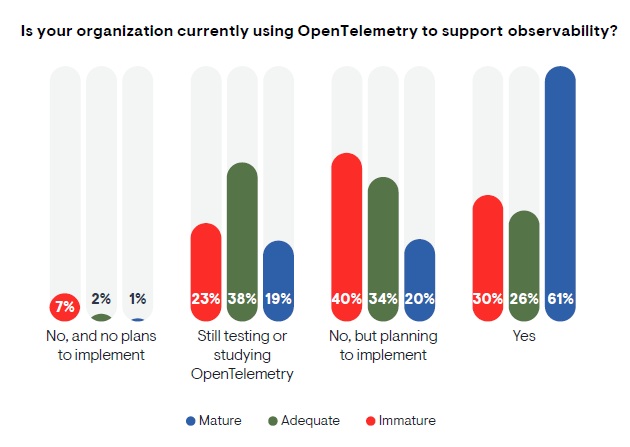
OpenTelemetry enjoys a positive perception, with half of respondents considering OpenTelemetry mature enough for implementation today, and another 31% considering it moderately mature and useful, according to a new EMA report, Taking Observability to the Next Level: OpenTelemetry's Emerging Role in IT Performance and Reliability ... and almost everyone surveyed (98.7%) expresses support for where OpenTelemetry is heading ...
Image
Open source dominance continues in observability, according to the Observability Survey from Grafana Labs. A remarkable 75% of respondents are now using open source licensing for observability, with 70% reporting that their organizations use both Prometheus and OpenTelemetry in some capacity. Half of all organizations increased their investments in both technologies for the second year in a row ...
Observability has become a critical component of managing modern, complex systems, helping organizations ensure uptime, optimize performance, and quickly diagnose issues ... But the tide is shifting. With open-source projects stepping in to fill key parts of the observability stack, the market is on the brink of a major disruption ...