
AIOps
Over the past few years, large language models (LLMs) have revolutionized the software industry. Given their ability to excel at multi-step reasoning, LLMs have helped enterprises streamline workflows and adapt to the unknown. However, employing such models comes with sky-high costs, latency issues, and limited flexibility. In the realm of IT operations, it is generally wiser to employ smaller, domain-specific models instead ...
For years, DevOps teams operated under a simple assumption: collect enough telemetry, and you can find and fix any problem. That assumption is breaking down. Modern enterprises now operate across microservices, hybrid cloud environments, APIs, Kubernetes, and highly automated delivery pipelines. Releases happen continuously, dependencies shift constantly, and failures spread faster than teams can diagnose them ...
Ask any senior SRE or platform engineer what keeps them up at night, and the answer probably isn't the monitoring tool — it's the data feeding it. The proliferation of APM, observability, and AIOps platforms has created a telemetry sprawl problem that most teams manage reactively rather than architect proactively. Metrics are going to one platform. Traces routed somewhere else. Logs duplicated across multiple backends because nobody wants to be caught without them when something breaks. Every redundant stream costs money ...
In the world of digital-first business, there is no tolerance for service outages. Businesses know that outages are the quickest way to lose money and customers. For smaller organizations, unplanned downtime could even force the business to close ... A new study from PagerDuty, The State of AI-First Operations, reveals that companies actively incorporating AI into operations now view operational resilience as a growth driver rather than a cost center. But how are they achieving it? ...
The financial stakes of extended service disruption has made operational resilience a top priority, according to 2026 State of AI-First Operations Report, a report from PagerDuty. According to survey findings, 95% of respondents believe their leadership understands the competitive advantage that can be gained from reducing incidents and speeding recovery ...
While 87% of manufacturing leaders and technical specialists report that ROI from their AIOps initiatives has met or exceeded expectations, only 37% say they are fully prepared to operationalize AI at scale, according to The Future of IT Operations in the AI Era, a report from Riverbed ...
In MEAN TIME TO INSIGHT Episode 21, Shamus McGillicuddy, VP of Research, Network Infrastructure and Operations, at EMA discusses AI-driven NetOps ...
Basic uptime is no longer the gold standard. By 2026, network monitoring must do more than report status, it must explain performance in a hybrid-first world. Networks are no longer just static support systems; they are agile, distributed architectures that sit at the very heart of the customer experience and the business outcomes ... The following five trends represent the new standard for network health, providing a blueprint for teams to move from reactive troubleshooting to a proactive, integrated future ...
In APMdigest's 2026 Observability Predictions Series, industry experts offer predictions on how Observability and related technologies will evolve and impact business in 2026. Part 7 covers Observability data ...
In APMdigest's 2026 Observability Predictions Series, industry experts offer predictions on how Observability and related technologies will evolve and impact business in 2026. Part 2 covers predictions about Observability and AIOps ...
The Holiday Season means it is time for APMdigest's annual list of predictions, covering Observability and other IT performance topics. Industry experts — from analysts and consultants to the top vendors — offer thoughtful, insightful, and often controversial predictions on how Observability, AIOps, APM and related technologies will evolve and impact business in 2026 ...
The rise of hybrid cloud environments, the explosion of IoT devices, the proliferation of remote work, and advanced cyber threats have created a monitoring challenge that traditional approaches simply cannot meet. IT teams find themselves drowning in a sea of data, struggling to identify critical threats amidst a deluge of alerts, and often reacting to incidents long after they've begun. This is where AI and ML are leveraged ...
Three practices, chaos testing, incident retrospectives, and AIOps-driven monitoring, are transforming platform teams from reactive responders into proactive builders of resilient, self-healing systems. The evolution is not just technical; it's cultural. The modern platform engineer isn't just maintaining infrastructure. They're product owners designing for reliability, observability, and continuous improvement ...
Traditional monitoring often stops at uptime and server health without any integrated insights. Cross-platform observability covers not just infrastructure telemetry but also client-side behavior, distributed service interactions, and the contextual data that connects them. Emerging technologies like OpenTelemetry, eBPF, and AI-driven anomaly detection have made this vision more achievable, but only if organizations ground their observability strategy in well-defined pillars. Here are the five foundational pillars of cross-platform observability that modern engineering teams should focus on for seamless platform performance ...
In today's fast-paced AI landscape, CIOs, IT leaders, and engineers are constantly challenged to manage increasingly complex and interconnected systems. The sheer scale and velocity of data generated by modern infrastructure can be overwhelming, making it difficult to maintain uptime, prevent outages, and create a seamless customer experience. This complexity is magnified by the industry's shift towards agentic AI ...
The biggest change in Cloud Managed Services 2.0 is how it unites domains that once operated in isolation. CloudOps, FinOps, DevOps, SecOps, and AIOps now work as a single, cohesive team instead of separate departments competing for resources and priorities. This matters because modern businesses operate at a pace that leaves traditional methods behind ...
For years, IT Operations has been caught in a loop of reacting to incidents after they've already caused disruption. Even with monitoring, observability, and AIOps 1.0 (legacy AIOps solutions) in place, teams still face overwhelming alert volumes, fragmented data, and slow mean time to resolution (MTTR). The move to Predictive IT Operations offers a better path ...
In Part 12, the final installment in the series, the experts present some final predictions about AI's future impact on APM and Observability ...
AI plays a transformative role in both APM and observability by turning raw data into actionable insights, enabling faster, more accurate detection and resolution of issues ...
Enterprises are turning to AI-powered software platforms to make IT management more intelligent and ensure their systems and technology meet business needs for efficiency, lowers costs and innovation, according to new research from Information Services Group ...
While there is high enthusiasm for AI — with 92% of those surveyed in the manufacturing industry confirming AI is a top C-Suite priority and 92% agree it provides a competitive advantage — only 32% of manufacturers are fully prepared to implement AI projects now, 5% lower than the overall industry average, according to Manufacturing sector results of the Riverbed Global AI & Digital Experience Survey ...
Image

Today's enterprises exist in rapidly growing, complex IT landscapes that can inadvertently create silos and lead to the accumulation of disparate tools. To successfully manage such growth, these organizations must realize the requisite shift in corporate culture and workflow management needed to build trust in new technologies. This is particularly true in cases where enterprises are turning to automation and autonomic IT to offload the burden from IT professionals. This interplay between technology and culture is crucial in guiding teams using AIOps and observability solutions to proactively manage operations and transition toward a machine-driven IT ecosystem ...
The surge in AI adoption amplifies the need for robust data center infrastructure to handle the terabytes of data being generated daily ... Still, as much as AI will benefit from data centers, data centers need observability solutions to ensure resiliency and sustainability so businesses can operate to their full potential and provide seamless experiences to customers ...
Today's IT environments are more complex than ever, with organizations managing an increasing number of applications, platforms, and systems. To maintain peak performance and ensure seamless digital experiences, businesses are turning to Artificial Intelligence for IT Operations (AIOps) ...
Image
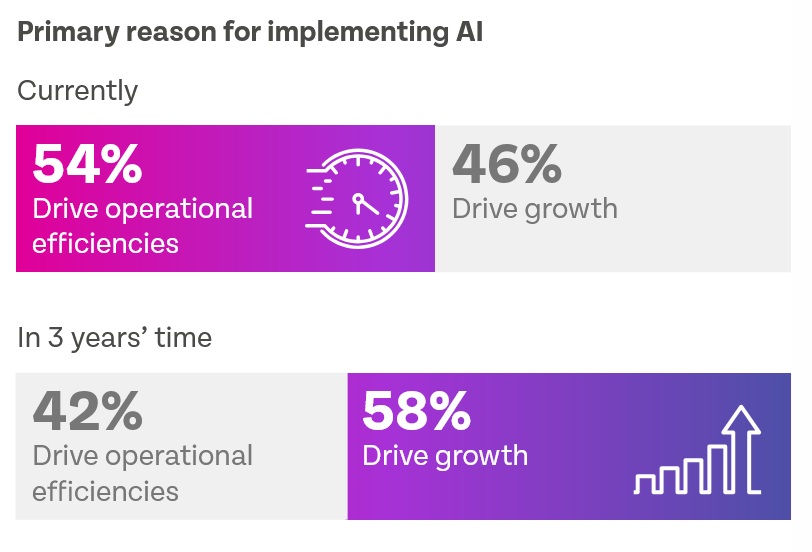
The adoption of artificial intelligence (AI) is accelerating across the telecoms industry, with 88% of fixed broadband service providers now investigating or trialing AI automation to enhance their fixed broadband services, according to new research from Incognito Software Systems and Omdia ...