

When Will SysAdmins Get the Respect They Deserve?

Ennio Carboni

The results are in from the latest version of Ipswitch’s annual Red Shirt Survey and the results highlight that IT network professionals are working harder than ever. To make matters worse, they are still feeling underappreciated and suffer from a general lack of respect within their organization.

The survey, which was conducted amongst more than 250 systems administrators from across the United States, indicated that while IT isn’t looking for grand gestures of gratitude, a simple “thank you” would go a long way. IT feels somewhat taken advantage of in the organization and would appreciate workers at least attempting some basic diagnosis such as ensuring their device is plugged in before pushing the panic button.

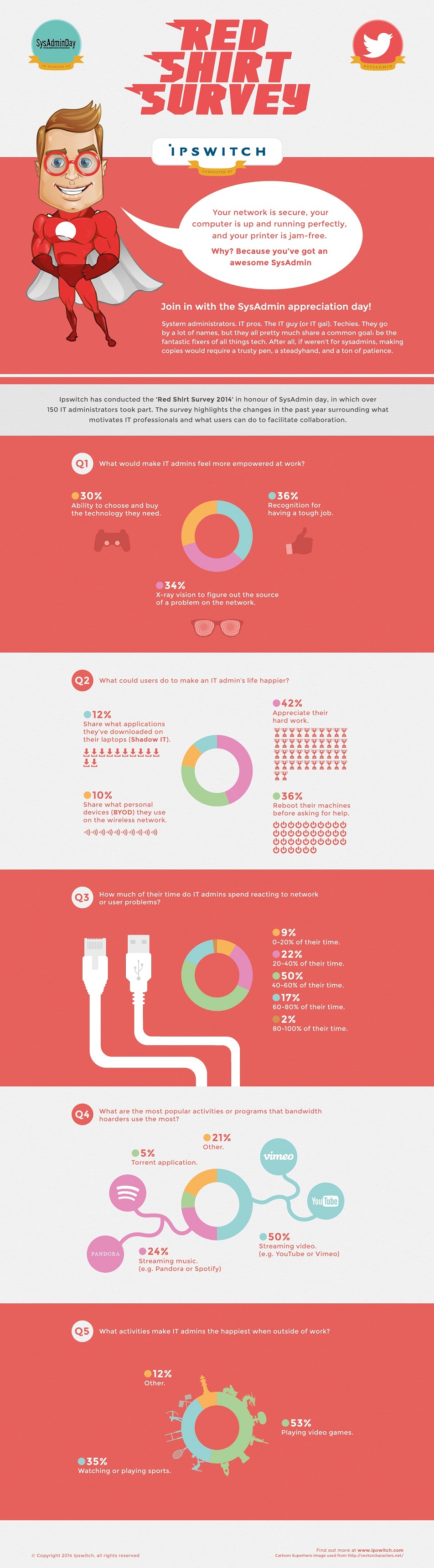
IT is under greater pressure than ever before to perform while also facing dwindling resources and budget, yet when we asked what would make them happier at work, more than 42 percent would just like more appreciation for his or her hard work from colleagues (aka users), up five percent over last year’s survey. Just over a third (36 percent) would like users to reboot their machines before asking for help. So as they say, it’s the simple things in life that matter.

SysAdmins also feel like they are spending way too much time reacting to problems on their IT networks rather than proactively making critical updates and conducting routine system maintenance. One out of every two SysAdmins (50 percent) spends between 40-60 percent of their time reacting to network or user problems, an increase of more than 10 percent from last year. Nearly one in six (17 percent) indicated that they spend a whopping 60-80 percent of their time dealing with frustrations on their networks.

Recognition of having a tough job is critically important to IT. We found more than a third (36 percent) of SysAdmins simply want it to be noted that they serve an important role and have a difficult assignment, nearly double from last year’s survey. In addition, 34 percent would like x-ray vision to figure out the source of a problem on a network, up six percent from last year. And if that’s not possible, half of them would just be happy with users cutting down on the amount of media streaming they do. One in two SysAdmins (50 percent) noted that video platforms like YouTube or Vimeo are the biggest culprits when it comes to bandwidth hoarding.

SysAdmins have a difficult but thankless job within most organizations. They routinely work night and day to keep our networks and applications humming along. They aren’t looking for platitudes, just some common courtesy and expressions of thanks. Ensuring their colleagues are equipped with the technology and support they need to innovate, collaborate and do their jobs can create a lot of pressure, so when you see one of your SysAdmin colleagues today, a simple ‘thank you for everything you do’ would go a long way.

Ennio Carboni is Executive Vice President, Customer Solutions, Ipswitch.

Hot Topics

The Latest

In live financial environments, capital markets software cannot pause for rebuilds. New capabilities are introduced as stacked technology layers to meet evolving demands while systems remain active, data keeps moving, and controls stay intact. AI is no exception, and its opportunities are significant: accelerated decision cycles, compressed manual workflows, and more effective operations across complex environments. The constraint isn't the models themselves, but the architectural environments they enter ...

Like most digital transformation shifts, organizations often prioritize productivity and leave security and observability to keep pace. This usually translates to both the mass implementation of new technology and fragmented monitoring and observability (M&O) tooling. In the era of AI and varied cloud architecture, a disparate observability function can be dangerous. IT teams will lack a complete picture of their IT environment, making it harder to diagnose issues while slowing down mean time to resolve (MTTR). In fact, according to recent data from the SolarWinds State of Monitoring & Observability Report, 77% of IT personnel said the lack of visibility across their on-prem and cloud architecture was an issue ...

In MEAN TIME TO INSIGHT Episode 23, Shamus McGillicuddy, VP of Research, Network Infrastructure and Operations, at EMA discusses the NetOps labor shortage ... 

Technology management is evolving, and in turn, so is the scope of FinOps. The FinOps Foundation recently updated their mission statement from "advancing the people who manage the value of cloud" to "advancing the people who manage the value of technology." This seemingly small change solidifies a larger evolution: FinOps practitioners have organically expanded to be focused on more than just cloud cost optimization. Today, FinOps teams are largely — and quickly — expanding their job descriptions, evolving into a critical function for managing the full value of technology ...

Enterprises are under pressure to scale AI quickly. Yet despite considerable investment, adoption continues to stall. One of the most overlooked reasons is vendor sprawl ... In reality, no organization deliberately sets out to create sprawling vendor ecosystems. More often, complexity accumulates over time through well-intentioned initiatives, such as enterprise-wide digital transformation efforts, point solutions, or decentralized sourcing strategies ...

When Will SysAdmins Get the Respect They Deserve?

Ennio Carboni

The results are in from the latest version of Ipswitch’s annual Red Shirt Survey and the results highlight that IT network professionals are working harder than ever. To make matters worse, they are still feeling underappreciated and suffer from a general lack of respect within their organization.

The survey, which was conducted amongst more than 250 systems administrators from across the United States, indicated that while IT isn’t looking for grand gestures of gratitude, a simple “thank you” would go a long way. IT feels somewhat taken advantage of in the organization and would appreciate workers at least attempting some basic diagnosis such as ensuring their device is plugged in before pushing the panic button.

IT is under greater pressure than ever before to perform while also facing dwindling resources and budget, yet when we asked what would make them happier at work, more than 42 percent would just like more appreciation for his or her hard work from colleagues (aka users), up five percent over last year’s survey. Just over a third (36 percent) would like users to reboot their machines before asking for help. So as they say, it’s the simple things in life that matter.

SysAdmins also feel like they are spending way too much time reacting to problems on their IT networks rather than proactively making critical updates and conducting routine system maintenance. One out of every two SysAdmins (50 percent) spends between 40-60 percent of their time reacting to network or user problems, an increase of more than 10 percent from last year. Nearly one in six (17 percent) indicated that they spend a whopping 60-80 percent of their time dealing with frustrations on their networks.

Recognition of having a tough job is critically important to IT. We found more than a third (36 percent) of SysAdmins simply want it to be noted that they serve an important role and have a difficult assignment, nearly double from last year’s survey. In addition, 34 percent would like x-ray vision to figure out the source of a problem on a network, up six percent from last year. And if that’s not possible, half of them would just be happy with users cutting down on the amount of media streaming they do. One in two SysAdmins (50 percent) noted that video platforms like YouTube or Vimeo are the biggest culprits when it comes to bandwidth hoarding.

SysAdmins have a difficult but thankless job within most organizations. They routinely work night and day to keep our networks and applications humming along. They aren’t looking for platitudes, just some common courtesy and expressions of thanks. Ensuring their colleagues are equipped with the technology and support they need to innovate, collaborate and do their jobs can create a lot of pressure, so when you see one of your SysAdmin colleagues today, a simple ‘thank you for everything you do’ would go a long way.

Ennio Carboni is Executive Vice President, Customer Solutions, Ipswitch.


Hot Topics

The Latest

In live financial environments, capital markets software cannot pause for rebuilds. New capabilities are introduced as stacked technology layers to meet evolving demands while systems remain active, data keeps moving, and controls stay intact. AI is no exception, and its opportunities are significant: accelerated decision cycles, compressed manual workflows, and more effective operations across complex environments. The constraint isn't the models themselves, but the architectural environments they enter ...

Like most digital transformation shifts, organizations often prioritize productivity and leave security and observability to keep pace. This usually translates to both the mass implementation of new technology and fragmented monitoring and observability (M&O) tooling. In the era of AI and varied cloud architecture, a disparate observability function can be dangerous. IT teams will lack a complete picture of their IT environment, making it harder to diagnose issues while slowing down mean time to resolve (MTTR). In fact, according to recent data from the SolarWinds State of Monitoring & Observability Report, 77% of IT personnel said the lack of visibility across their on-prem and cloud architecture was an issue ...

In MEAN TIME TO INSIGHT Episode 23, Shamus McGillicuddy, VP of Research, Network Infrastructure and Operations, at EMA discusses the NetOps labor shortage ... 

Technology management is evolving, and in turn, so is the scope of FinOps. The FinOps Foundation recently updated their mission statement from "advancing the people who manage the value of cloud" to "advancing the people who manage the value of technology." This seemingly small change solidifies a larger evolution: FinOps practitioners have organically expanded to be focused on more than just cloud cost optimization. Today, FinOps teams are largely — and quickly — expanding their job descriptions, evolving into a critical function for managing the full value of technology ...

Enterprises are under pressure to scale AI quickly. Yet despite considerable investment, adoption continues to stall. One of the most overlooked reasons is vendor sprawl ... In reality, no organization deliberately sets out to create sprawling vendor ecosystems. More often, complexity accumulates over time through well-intentioned initiatives, such as enterprise-wide digital transformation efforts, point solutions, or decentralized sourcing strategies ...