


The 2023 State of IT Operations Survey Results Are In

Jon Levenson
Automox

It's never easy to forecast the future. But lately, life and work have gotten even more unpredictable. It's no secret we're living through days of heavy economic and workplace uncertainty. Unfortunately, in such times, IT operations teams are up against even more endpoint management challenges than usual. A surplus of software and devices means avalanches of complexity and escalating endpoint diversity within organizations' IT environments. Plus, in many cases, today's financial crunch will translate to companies cutting back on hiring, tightening budgets, limiting spending on tools, and pushing teams – already running on fumes – to do more with less. How are you supposed to overcome all this?

Teams want fast, scalable ways to make it easier to manage their complex IT environments

In the 2023 State of IT Operations Report, nearly 500 IT operations professionals from across the United States expressed their hunger for more efficient ways to centralize and simplify IT operations. Teams want fast, scalable ways to make it easier to manage their complex IT environments. Frankly, there's really only one solution: automation.
 

Automation to the Rescue

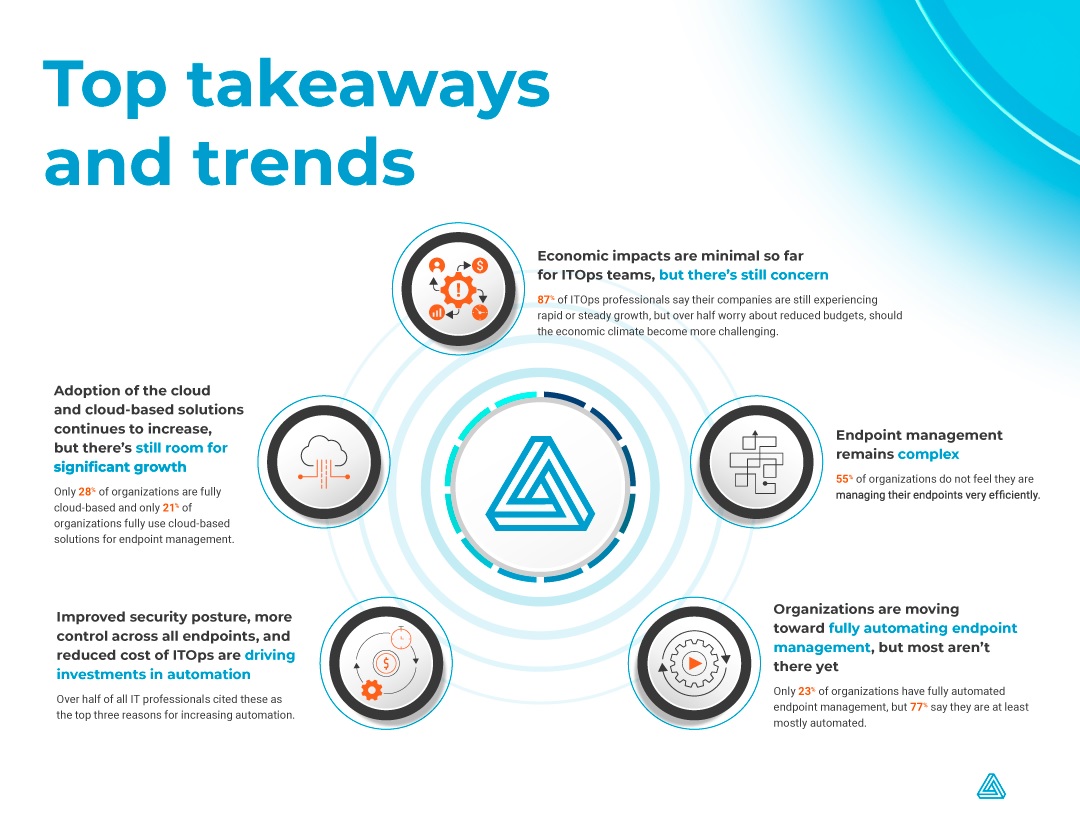
This year, the survey behind the State of IT Operations Report dug into IT teams' most challenging efficiency hurdles and limitations. The results showcase significant discoveries about how automation is increasing IT agility, reducing costs, and enhancing IT operations teams' endpoint management capabilities in the modern workplace. Here's a sneak peek at some of the findings: ■ 87% of ITOps professionals say their companies are still experiencing rapid or steady growth, but over half worry about reduced budgets, should the economic climate become more challenging. ■ 55% of organizations do not feel they are managing their endpoints very efficiently. ■ Only 23% of organizations have fully automated endpoint management, but 77% say they are at least mostly automated.

How Will IT Teams Clear Endpoint Management Hurdles? Trust in Automation

Learning to trust automation to tackle previously manual tasks is key – but easier said than done. ITOps teams often worry about human error, ineffective workflow, or complex setup if they choose to adopt automation fully. But automation isn't about relinquishing your hold on your endpoints – in fact, automation has evolved to give teams tighter visibility and control than ever, and without the costly manual effort. As you'll note when you read the State of IT Operations Report, automating endpoints is an essential productivity enabler. Plus, it's a catalyst to assure your IT leadership you can take your org forward.  Because many orgs are upping their attention to reduced costs, control over diverse endpoint landscapes, and improving their security posture there's no better time than now to start putting your trust in automation. Click on image for larger version
 

So, How Will Your Team Win the Endpoint Management Game?

There are radical ways to boost efficiency with automation while maintaining control over your diverse IT environment. Dig deeper into automation insights and share the State of IT Operations survey findings with your team by downloading the full report here.

Jon Levenson is Technical Content Writer/Editor at Automox

Hot Topics

The Latest

IT organizations have historically measured success by how quickly they can respond when something goes wrong. The entire discipline of Incident Management has been optimized around mean time to resolution, first-response SLAs and ticket closure rates. But new research suggests that even though this is a well-executed playbook, it's no longer enough to retain customers ...

Production incidents rarely announce themselves as database problems. They appear as slow transactions, timeouts, rising response times, or an application struggling under a workload it previously handled. APM provides an essential starting point. It can identify a slow transaction path, highlight an affected service, and show that a database dependency is consuming more time than expected. But identifying the database as part of the problem is not the same as explaining what is happening inside it ...

Cloud teams are under constant pressure to reduce spend without slowing development or increasing operational risk. They are deploying autoscalers, rightsizing workloads, enforcing resource requests, reviewing utilization dashboards, and building FinOps processes around cloud-native environments. Yet the results often disappoint ...

Ask most IT leaders about their biggest concern with AI and you'll hear the same answer: hallucinations ... Today, however, the conversation has shifted ... As organizations move beyond chatbots and experiments, they are increasingly deploying AI agents that perform multi-step tasks. These systems retrieve documents, query databases, call APIs, generate reports, write code, and make recommendations. The issue is not whether the model can reason. The issue is whether the organization can see, verify, and govern the decisions being made along the way ...

While organizations want to take control of their telemetry, building telemetry pipelines from scratch can be a very daunting, complicated task, even when leveraging open-source standards like OpenTelemetry. It requires specialized knowledge across distributed systems, data engineering, and security. This fragmented approach across systems causes higher operational costs; it puts a strain on resources and reduces efficiency as teams have to work with different interfaces and processes ...

For decades, enterprise networks were designed around a simple assumption: work happened inside the office. Applications lived in centralized data centers, employees connected through internal infrastructure, and security focused on protecting the perimeter that surrounded everything ... But the way organizations operate today bears little resemblance to that environment. Cloud platforms host critical applications, employees connect from homes and airports as often as they do from offices, and partners collaborate through shared systems that exist far beyond corporate walls. In short, the corporate network no longer resembles the environment it was designed to protect ...

As an analyst who researches how IT organizations design, build, and operate their networks, I find that network data is a constant source of pain. Network teams struggle with data quality, fragmentation, authority, access, and trust. And these issues undermine everything they try to do. Here are the numbers: Only 45% of network teams are completely confident in the accuracy of their network source of truth, which documents the intent of their network ...

The 2026 Global Data Center Survey from Uptime Institute reveals an industry navigating workforce constraints, escalating outage expenses, even as rising costs remain the top concern for management teams ...

The next observability gap may not be in the code. It may be under the rack. That sounds strange until you think about how AI incidents actually feel in the middle of an investigation ... The application dashboard may be accurate. It may also be stopping at the wrong boundary. AI systems depend on software, but they also depend on a dense physical stack: racks, power paths, thermal margin, maintenance activity and, in many environments, liquid cooling. Those physical dependencies can change slowly before they look like a software incident ...

Certificate expiration is the rare outage you can see coming. Every TLS certificate carries the date it stops working, so the moment it will begin breaking connections is knowable in advance. That's what makes an expired certificate such a frustrating way to lose a service. What's changing now is how often that date comes around ...

The 2023 State of IT Operations Survey Results Are In

Jon Levenson
Automox

It's never easy to forecast the future. But lately, life and work have gotten even more unpredictable. It's no secret we're living through days of heavy economic and workplace uncertainty. Unfortunately, in such times, IT operations teams are up against even more endpoint management challenges than usual. A surplus of software and devices means avalanches of complexity and escalating endpoint diversity within organizations' IT environments. Plus, in many cases, today's financial crunch will translate to companies cutting back on hiring, tightening budgets, limiting spending on tools, and pushing teams – already running on fumes – to do more with less. How are you supposed to overcome all this?

Teams want fast, scalable ways to make it easier to manage their complex IT environments

In the 2023 State of IT Operations Report, nearly 500 IT operations professionals from across the United States expressed their hunger for more efficient ways to centralize and simplify IT operations. Teams want fast, scalable ways to make it easier to manage their complex IT environments. Frankly, there's really only one solution: automation.
 

Automation to the Rescue

This year, the survey behind the State of IT Operations Report dug into IT teams' most challenging efficiency hurdles and limitations. The results showcase significant discoveries about how automation is increasing IT agility, reducing costs, and enhancing IT operations teams' endpoint management capabilities in the modern workplace. Here's a sneak peek at some of the findings: ■ 87% of ITOps professionals say their companies are still experiencing rapid or steady growth, but over half worry about reduced budgets, should the economic climate become more challenging. ■ 55% of organizations do not feel they are managing their endpoints very efficiently. ■ Only 23% of organizations have fully automated endpoint management, but 77% say they are at least mostly automated.

How Will IT Teams Clear Endpoint Management Hurdles? Trust in Automation

Learning to trust automation to tackle previously manual tasks is key – but easier said than done. ITOps teams often worry about human error, ineffective workflow, or complex setup if they choose to adopt automation fully. But automation isn't about relinquishing your hold on your endpoints – in fact, automation has evolved to give teams tighter visibility and control than ever, and without the costly manual effort. As you'll note when you read the State of IT Operations Report, automating endpoints is an essential productivity enabler. Plus, it's a catalyst to assure your IT leadership you can take your org forward.  Because many orgs are upping their attention to reduced costs, control over diverse endpoint landscapes, and improving their security posture there's no better time than now to start putting your trust in automation. Click on image for larger version
 

So, How Will Your Team Win the Endpoint Management Game?

There are radical ways to boost efficiency with automation while maintaining control over your diverse IT environment. Dig deeper into automation insights and share the State of IT Operations survey findings with your team by downloading the full report here.

Jon Levenson is Technical Content Writer/Editor at Automox

Hot Topics

The Latest

IT organizations have historically measured success by how quickly they can respond when something goes wrong. The entire discipline of Incident Management has been optimized around mean time to resolution, first-response SLAs and ticket closure rates. But new research suggests that even though this is a well-executed playbook, it's no longer enough to retain customers ...

Production incidents rarely announce themselves as database problems. They appear as slow transactions, timeouts, rising response times, or an application struggling under a workload it previously handled. APM provides an essential starting point. It can identify a slow transaction path, highlight an affected service, and show that a database dependency is consuming more time than expected. But identifying the database as part of the problem is not the same as explaining what is happening inside it ...

Cloud teams are under constant pressure to reduce spend without slowing development or increasing operational risk. They are deploying autoscalers, rightsizing workloads, enforcing resource requests, reviewing utilization dashboards, and building FinOps processes around cloud-native environments. Yet the results often disappoint ...

Ask most IT leaders about their biggest concern with AI and you'll hear the same answer: hallucinations ... Today, however, the conversation has shifted ... As organizations move beyond chatbots and experiments, they are increasingly deploying AI agents that perform multi-step tasks. These systems retrieve documents, query databases, call APIs, generate reports, write code, and make recommendations. The issue is not whether the model can reason. The issue is whether the organization can see, verify, and govern the decisions being made along the way ...

While organizations want to take control of their telemetry, building telemetry pipelines from scratch can be a very daunting, complicated task, even when leveraging open-source standards like OpenTelemetry. It requires specialized knowledge across distributed systems, data engineering, and security. This fragmented approach across systems causes higher operational costs; it puts a strain on resources and reduces efficiency as teams have to work with different interfaces and processes ...

For decades, enterprise networks were designed around a simple assumption: work happened inside the office. Applications lived in centralized data centers, employees connected through internal infrastructure, and security focused on protecting the perimeter that surrounded everything ... But the way organizations operate today bears little resemblance to that environment. Cloud platforms host critical applications, employees connect from homes and airports as often as they do from offices, and partners collaborate through shared systems that exist far beyond corporate walls. In short, the corporate network no longer resembles the environment it was designed to protect ...

As an analyst who researches how IT organizations design, build, and operate their networks, I find that network data is a constant source of pain. Network teams struggle with data quality, fragmentation, authority, access, and trust. And these issues undermine everything they try to do. Here are the numbers: Only 45% of network teams are completely confident in the accuracy of their network source of truth, which documents the intent of their network ...

The 2026 Global Data Center Survey from Uptime Institute reveals an industry navigating workforce constraints, escalating outage expenses, even as rising costs remain the top concern for management teams ...

The next observability gap may not be in the code. It may be under the rack. That sounds strange until you think about how AI incidents actually feel in the middle of an investigation ... The application dashboard may be accurate. It may also be stopping at the wrong boundary. AI systems depend on software, but they also depend on a dense physical stack: racks, power paths, thermal margin, maintenance activity and, in many environments, liquid cooling. Those physical dependencies can change slowly before they look like a software incident ...

Certificate expiration is the rare outage you can see coming. Every TLS certificate carries the date it stops working, so the moment it will begin breaking connections is knowable in advance. That's what makes an expired certificate such a frustrating way to lose a service. What's changing now is how often that date comes around ...