


5 Best Practices for Network Bandwidth Management

Preparation is key to keeping networks running smoothly despite March Madness live streaming

Even non-sports fans can get swept up in March Madness mania – creating brackets, participating in office pools and reigniting old college rivalries can be a fun way to get through the last dregs of winter and liven up the office environment. However, when it comes to live streaming games on company-owned devices, on the company network and/or during office hours, end users can wreak havoc on the network. Jump to Bandwidth Risk Assessment infographic below So how can IT pros prepare for March Madness (and other popular live streaming events)? We've compiled five tips to help keep networks running smoothly:

1. Educate

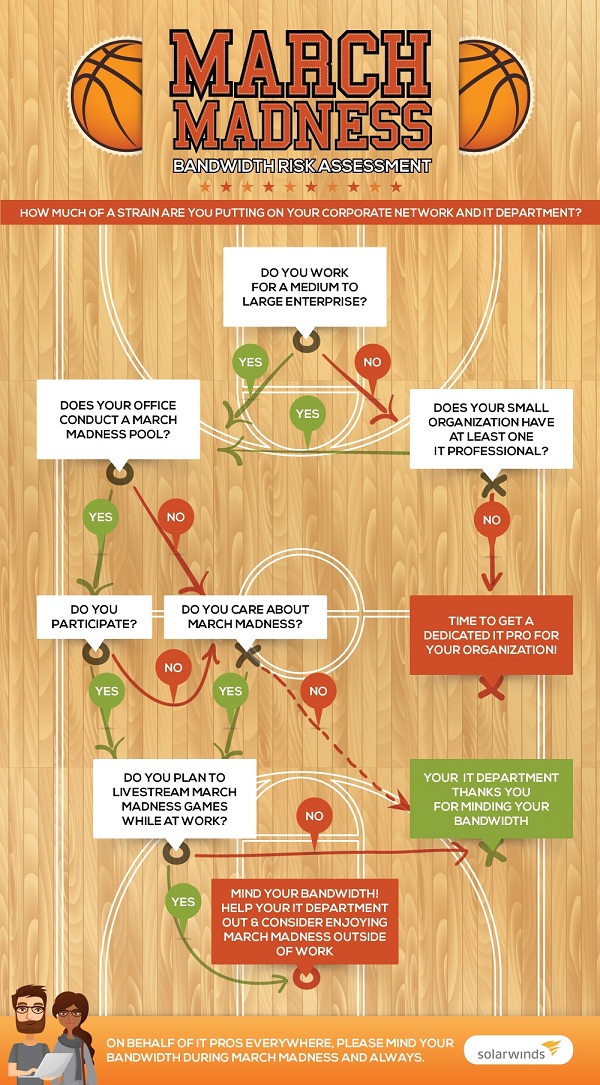
Sometimes it takes a gentle nudge to remind end users that live streaming non-work related content on company property during work hours isn't the best use of their time or the company's resources. We created a handy decision-making flowchart that you can share to help employees draw the ultimate conclusion: during March Madness, mind your bandwidth!

2. Monitor Your Current Traffic Profile

There are numerous hardware and software tools that allow you to monitor, profile and baseline your current network traffic to identify when and how bandwidth is being consumed, as well as by whom and by what applications. Further, many tools will give you the ability to map bandwidth usage and its impact on your applications.

3. Establish Traffic Management or Quality of Service (QoS) Policies

Various network traffic management tools allow you to establish and monitor QoS policies to ensure that business-critical traffic, such as voice over IP (VOIP) or Web access to cloud-based applications, takes priority over nonessential traffic.

4. Optimize WAN Capacity or WAN Links

Purchasing additional bandwidth is not the only way to increase your WAN capacity. WAN acceleration will effectively increase or optimize the usage of your WAN. Or if you utilize multiple WAN links, you can direct your business-critical traffic across one link while sending the less essential traffic across another.

5. Back Up Your Network Configurations

Just in case your network does go down, you need to ensure that you have backed up your device configurations so you can quickly revert back to a known good configuration. By following these five tips, you can prevent fouling out on network uptime and turn bandwidth management during March Madness into a slam dunk!

ABOUT Brad Hale

Brad Hale joined SolarWinds in 2009 and is the Product Marketing Principal for network management products, bringing over 20 years of product management, product marketing, business development and strategy experience in the software, systems, and semiconductor industries. Hale holds an MBA from Butler University and a BS in Computer Engineering from Purdue University.
 

Hot Topics

The Latest

Enterprises today operate in a real-time environment where uninterrupted access to trusted data has become a baseline expectation for users, applications and automated systems. Traditional DataOps models, built on manual effort and human triage, cannot keep pace with this always active demand. AI agents are emerging as the operational backbone, ensuring consistent data availability, reinforcing trustworthiness and enabling a level of scale that manual processes cannot achieve ...

For decades, trust in the digital workplace rested on familiar signals. We trusted faces on video calls, voices on the phone, and emails that appeared to come from people we knew. These cues felt human and intuitive. They anchored how decisions were made, approvals were granted, and access was authorized. AI-powered deepfakes have quietly broken that model ...

Cloud migration was supposed to be a one-way door. For most enterprises, it turns out it isn't. Cloud data repatriation is a real and growing trend. A new survey ... finds that 89% of organizations plan to expand their on-premises infrastructure footprint over the next two years — and 75% have already moved at least some workloads back from public cloud in the past 24 months. The findings point to a broad rethinking of where data belongs ...

Over the past few years, large language models (LLMs) have revolutionized the software industry. Given their ability to excel at multi-step reasoning, LLMs have helped enterprises streamline workflows and adapt to the unknown. However, employing such models comes with sky-high costs, latency issues, and limited flexibility. In the realm of IT operations, it is generally wiser to employ smaller, domain-specific models instead ...

For years, DevOps teams operated under a simple assumption: collect enough telemetry, and you can find and fix any problem. That assumption is breaking down. Modern enterprises now operate across microservices, hybrid cloud environments, APIs, Kubernetes, and highly automated delivery pipelines. Releases happen continuously, dependencies shift constantly, and failures spread faster than teams can diagnose them ...

5 Best Practices for Network Bandwidth Management

Preparation is key to keeping networks running smoothly despite March Madness live streaming

Even non-sports fans can get swept up in March Madness mania – creating brackets, participating in office pools and reigniting old college rivalries can be a fun way to get through the last dregs of winter and liven up the office environment. However, when it comes to live streaming games on company-owned devices, on the company network and/or during office hours, end users can wreak havoc on the network. Jump to Bandwidth Risk Assessment infographic below So how can IT pros prepare for March Madness (and other popular live streaming events)? We've compiled five tips to help keep networks running smoothly:

1. Educate

Sometimes it takes a gentle nudge to remind end users that live streaming non-work related content on company property during work hours isn't the best use of their time or the company's resources. We created a handy decision-making flowchart that you can share to help employees draw the ultimate conclusion: during March Madness, mind your bandwidth!

2. Monitor Your Current Traffic Profile

There are numerous hardware and software tools that allow you to monitor, profile and baseline your current network traffic to identify when and how bandwidth is being consumed, as well as by whom and by what applications. Further, many tools will give you the ability to map bandwidth usage and its impact on your applications.

3. Establish Traffic Management or Quality of Service (QoS) Policies

Various network traffic management tools allow you to establish and monitor QoS policies to ensure that business-critical traffic, such as voice over IP (VOIP) or Web access to cloud-based applications, takes priority over nonessential traffic.

4. Optimize WAN Capacity or WAN Links

Purchasing additional bandwidth is not the only way to increase your WAN capacity. WAN acceleration will effectively increase or optimize the usage of your WAN. Or if you utilize multiple WAN links, you can direct your business-critical traffic across one link while sending the less essential traffic across another.

5. Back Up Your Network Configurations

Just in case your network does go down, you need to ensure that you have backed up your device configurations so you can quickly revert back to a known good configuration. By following these five tips, you can prevent fouling out on network uptime and turn bandwidth management during March Madness into a slam dunk!

ABOUT Brad Hale

Brad Hale joined SolarWinds in 2009 and is the Product Marketing Principal for network management products, bringing over 20 years of product management, product marketing, business development and strategy experience in the software, systems, and semiconductor industries. Hale holds an MBA from Butler University and a BS in Computer Engineering from Purdue University.

 

Hot Topics

The Latest

Enterprises today operate in a real-time environment where uninterrupted access to trusted data has become a baseline expectation for users, applications and automated systems. Traditional DataOps models, built on manual effort and human triage, cannot keep pace with this always active demand. AI agents are emerging as the operational backbone, ensuring consistent data availability, reinforcing trustworthiness and enabling a level of scale that manual processes cannot achieve ...

For decades, trust in the digital workplace rested on familiar signals. We trusted faces on video calls, voices on the phone, and emails that appeared to come from people we knew. These cues felt human and intuitive. They anchored how decisions were made, approvals were granted, and access was authorized. AI-powered deepfakes have quietly broken that model ...

Cloud migration was supposed to be a one-way door. For most enterprises, it turns out it isn't. Cloud data repatriation is a real and growing trend. A new survey ... finds that 89% of organizations plan to expand their on-premises infrastructure footprint over the next two years — and 75% have already moved at least some workloads back from public cloud in the past 24 months. The findings point to a broad rethinking of where data belongs ...

Over the past few years, large language models (LLMs) have revolutionized the software industry. Given their ability to excel at multi-step reasoning, LLMs have helped enterprises streamline workflows and adapt to the unknown. However, employing such models comes with sky-high costs, latency issues, and limited flexibility. In the realm of IT operations, it is generally wiser to employ smaller, domain-specific models instead ...

For years, DevOps teams operated under a simple assumption: collect enough telemetry, and you can find and fix any problem. That assumption is breaking down. Modern enterprises now operate across microservices, hybrid cloud environments, APIs, Kubernetes, and highly automated delivery pipelines. Releases happen continuously, dependencies shift constantly, and failures spread faster than teams can diagnose them ...