
The eCommerce Holiday Prep List

Stephen Gates

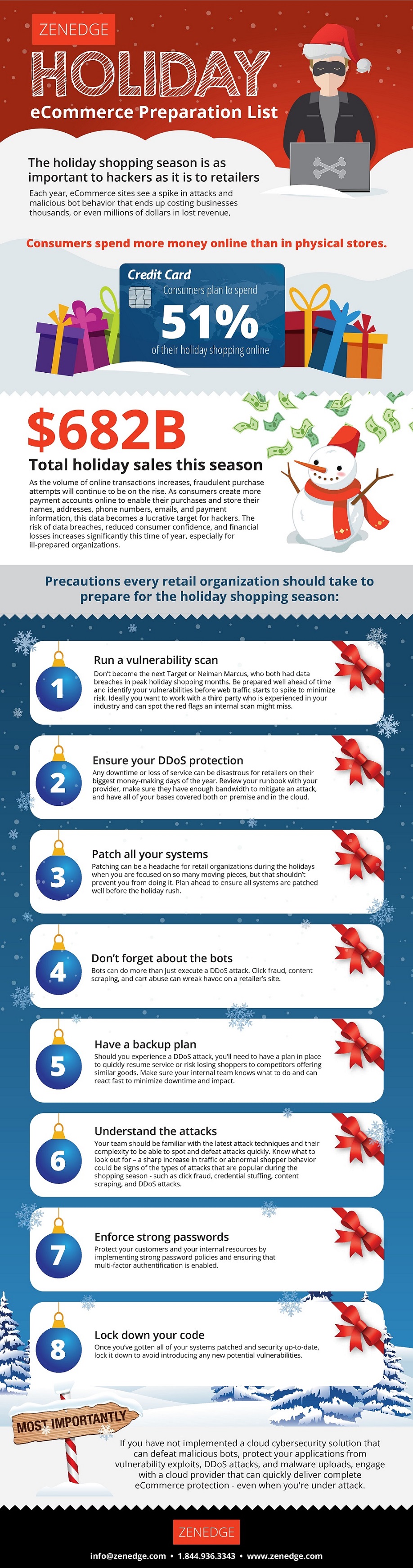
As the 2017 holiday shopping season gets under way, with sales expected to hit $682 billion, this year could be the first that consumers spend more online than in stores. In fact, they may spend more than half of their holiday dollars online this year. As more people flock to e-commerce sites than ever before, the potential threat to retailers from hackers increases exponentially.

Jump to Infographic Below

As the volume of online transactions rises, fraudulent purchase attempts, denial of service (DoS) attacks and detrimental bot behavior spike, leaving retailers at risk of losing thousands, or even millions, in revenue on their busiest money making days of the year and could leave their reputations in shambles. Just think back to Target and Neiman Marcus who had breaches in peak holiday season.

Due to the massive data breaches reported this year, whereby hundreds-of-millions of identities were stolen, hackers and their bot armies are positioned quite well for a lucrative holiday season. Expect significant increases in counterfeit purchasers using fraudulent credit cards. In addition, hackers and their bot armies are likely to repetitively make and cancel purchases, hold and/or consume inventory, scrape sites, steal information, and a host of other unwanted activities. Since this is the time of year when retailers experience significant increases in sales (as compared to the rest of the year), it's imperative for retailers to take these threats serious, and plan for the worst.

Hacking tools are increasingly more available, DDoS botnets made up of infected IoT are growing in size and firepower, and launching cyberattacks are getting cheaper by the minute. There are more outfits in Russia, China, and elsewhere hacking for their own financial gain, and others are readily available for hire for lower costs than seen previously. The global political landscape, domestic discontent, and heightened security concerns will likely increase consumers' online purchases vs. going to malls and other physical outlets. This holiday season will be the perfect time to for hackers to target and disrupt the shopping season, creating havoc and causing chaos. Damages and losses could very well be at an all time high.

In order to combat these behaviors, see the checklist of precautions every retailer should keep in mind to prepare ahead of the holiday rush, including running a vulnerability scan, patching all systems, ensuring DoS protection, implementing a backup plan and understanding the potential attacks and your vulnerabilities, among other preparations.

Hot Topics

The Latest

Enterprises today operate in a real-time environment where uninterrupted access to trusted data has become a baseline expectation for users, applications and automated systems. Traditional DataOps models, built on manual effort and human triage, cannot keep pace with this always active demand. AI agents are emerging as the operational backbone, ensuring consistent data availability, reinforcing trustworthiness and enabling a level of scale that manual processes cannot achieve ...

For decades, trust in the digital workplace rested on familiar signals. We trusted faces on video calls, voices on the phone, and emails that appeared to come from people we knew. These cues felt human and intuitive. They anchored how decisions were made, approvals were granted, and access was authorized. AI-powered deepfakes have quietly broken that model ...

Cloud migration was supposed to be a one-way door. For most enterprises, it turns out it isn't. Cloud data repatriation is a real and growing trend. A new survey ... finds that 89% of organizations plan to expand their on-premises infrastructure footprint over the next two years — and 75% have already moved at least some workloads back from public cloud in the past 24 months. The findings point to a broad rethinking of where data belongs ...

Over the past few years, large language models (LLMs) have revolutionized the software industry. Given their ability to excel at multi-step reasoning, LLMs have helped enterprises streamline workflows and adapt to the unknown. However, employing such models comes with sky-high costs, latency issues, and limited flexibility. In the realm of IT operations, it is generally wiser to employ smaller, domain-specific models instead ...

For years, DevOps teams operated under a simple assumption: collect enough telemetry, and you can find and fix any problem. That assumption is breaking down. Modern enterprises now operate across microservices, hybrid cloud environments, APIs, Kubernetes, and highly automated delivery pipelines. Releases happen continuously, dependencies shift constantly, and failures spread faster than teams can diagnose them ...

New Relic surveyed IT and engineering leaders from the media and entertainment (M&E) sector to understand what's working — and where challenges persist with their observability practices. The findings reveal how M&E organizations are navigating rising platform complexity, audience expectations, and AI-driven change. Below are five takeaways that stand out ...

Let me start with something I've seen play out more times than I can count. A team hits a wall with the cloud. Costs creep up, then spike. Performance starts to feel inconsistent. Someone in finance asks a simple question like "why did this double?" and nobody has a clean answer ... Maybe this isn't the right place for everything. That realization feels like a breakthrough, like you've identified the problem. In reality, you've just identified the starting line ...

In MEAN TIME TO INSIGHT Episode 24, Shamus McGillicuddy, VP of Research, Network Infrastructure and Operations, at EMA discusses network observability tool sprawl ... 

In cloud-native systems, scaling is often as simple as moving a slider. For on-premise databases, the stakes are different. Over-provisioning hardware is expensive. Under-provisioning leads to performance bottlenecks that are difficult to fix once the equipment is in the rack ...

When most people think about cybersecurity, they picture firewalls, encryption, and access controls — technical tools designed to protect systems and data. But beneath the technology lies a deeper set of principles about trust, decision-making, and resilience ... The best leaders don't eliminate risk. They manage it intelligently. And in many ways, cybersecurity offers a surprisingly useful playbook for doing exactly that ...

The eCommerce Holiday Prep List

Stephen Gates

As the 2017 holiday shopping season gets under way, with sales expected to hit $682 billion, this year could be the first that consumers spend more online than in stores. In fact, they may spend more than half of their holiday dollars online this year. As more people flock to e-commerce sites than ever before, the potential threat to retailers from hackers increases exponentially.

Jump to Infographic Below

As the volume of online transactions rises, fraudulent purchase attempts, denial of service (DoS) attacks and detrimental bot behavior spike, leaving retailers at risk of losing thousands, or even millions, in revenue on their busiest money making days of the year and could leave their reputations in shambles. Just think back to Target and Neiman Marcus who had breaches in peak holiday season.

Due to the massive data breaches reported this year, whereby hundreds-of-millions of identities were stolen, hackers and their bot armies are positioned quite well for a lucrative holiday season. Expect significant increases in counterfeit purchasers using fraudulent credit cards. In addition, hackers and their bot armies are likely to repetitively make and cancel purchases, hold and/or consume inventory, scrape sites, steal information, and a host of other unwanted activities. Since this is the time of year when retailers experience significant increases in sales (as compared to the rest of the year), it's imperative for retailers to take these threats serious, and plan for the worst.

Hacking tools are increasingly more available, DDoS botnets made up of infected IoT are growing in size and firepower, and launching cyberattacks are getting cheaper by the minute. There are more outfits in Russia, China, and elsewhere hacking for their own financial gain, and others are readily available for hire for lower costs than seen previously. The global political landscape, domestic discontent, and heightened security concerns will likely increase consumers' online purchases vs. going to malls and other physical outlets. This holiday season will be the perfect time to for hackers to target and disrupt the shopping season, creating havoc and causing chaos. Damages and losses could very well be at an all time high.

In order to combat these behaviors, see the checklist of precautions every retailer should keep in mind to prepare ahead of the holiday rush, including running a vulnerability scan, patching all systems, ensuring DoS protection, implementing a backup plan and understanding the potential attacks and your vulnerabilities, among other preparations.


Hot Topics

The Latest

Enterprises today operate in a real-time environment where uninterrupted access to trusted data has become a baseline expectation for users, applications and automated systems. Traditional DataOps models, built on manual effort and human triage, cannot keep pace with this always active demand. AI agents are emerging as the operational backbone, ensuring consistent data availability, reinforcing trustworthiness and enabling a level of scale that manual processes cannot achieve ...

For decades, trust in the digital workplace rested on familiar signals. We trusted faces on video calls, voices on the phone, and emails that appeared to come from people we knew. These cues felt human and intuitive. They anchored how decisions were made, approvals were granted, and access was authorized. AI-powered deepfakes have quietly broken that model ...

Cloud migration was supposed to be a one-way door. For most enterprises, it turns out it isn't. Cloud data repatriation is a real and growing trend. A new survey ... finds that 89% of organizations plan to expand their on-premises infrastructure footprint over the next two years — and 75% have already moved at least some workloads back from public cloud in the past 24 months. The findings point to a broad rethinking of where data belongs ...

Over the past few years, large language models (LLMs) have revolutionized the software industry. Given their ability to excel at multi-step reasoning, LLMs have helped enterprises streamline workflows and adapt to the unknown. However, employing such models comes with sky-high costs, latency issues, and limited flexibility. In the realm of IT operations, it is generally wiser to employ smaller, domain-specific models instead ...

For years, DevOps teams operated under a simple assumption: collect enough telemetry, and you can find and fix any problem. That assumption is breaking down. Modern enterprises now operate across microservices, hybrid cloud environments, APIs, Kubernetes, and highly automated delivery pipelines. Releases happen continuously, dependencies shift constantly, and failures spread faster than teams can diagnose them ...

New Relic surveyed IT and engineering leaders from the media and entertainment (M&E) sector to understand what's working — and where challenges persist with their observability practices. The findings reveal how M&E organizations are navigating rising platform complexity, audience expectations, and AI-driven change. Below are five takeaways that stand out ...

Let me start with something I've seen play out more times than I can count. A team hits a wall with the cloud. Costs creep up, then spike. Performance starts to feel inconsistent. Someone in finance asks a simple question like "why did this double?" and nobody has a clean answer ... Maybe this isn't the right place for everything. That realization feels like a breakthrough, like you've identified the problem. In reality, you've just identified the starting line ...

In MEAN TIME TO INSIGHT Episode 24, Shamus McGillicuddy, VP of Research, Network Infrastructure and Operations, at EMA discusses network observability tool sprawl ... 

In cloud-native systems, scaling is often as simple as moving a slider. For on-premise databases, the stakes are different. Over-provisioning hardware is expensive. Under-provisioning leads to performance bottlenecks that are difficult to fix once the equipment is in the rack ...

When most people think about cybersecurity, they picture firewalls, encryption, and access controls — technical tools designed to protect systems and data. But beneath the technology lies a deeper set of principles about trust, decision-making, and resilience ... The best leaders don't eliminate risk. They manage it intelligently. And in many ways, cybersecurity offers a surprisingly useful playbook for doing exactly that ...