

IT Teams Name Network and Application Monitoring a Top Challenge for 2016

Jeff Loeb

All companies rely on having a fast and efficient network. Ensuring optimal network performance is no easy feat for IT teams that are tasked with keeping networks running efficiently and effectively around the clock. A new report from Ipswitch proved that this is a major concern for IT teams coping with increasing complexity – when asked what their top challenge would be in 2016, IT infrastructure and application performance monitoring was the second-leading response.

For this report, Ipswitch polled 2,685 IT professionals to determine the top IT concerns for 2016. The responses, which represented IT pros from all regions of the globe, were analyzed and categorized into eight distinct topic areas. The leading issue was security (25 percent), followed IT infrastructure and application performance monitoring (19 percent) and new technology, updates and deployment (14 percent).

Within the infrastructure category, visibility into the entire infrastructure including systems, MS apps, network, virtual environments, web servers, HTML certificates, etc. was seen as the largest concern for 50 percent of IT teams. General networking performance concerns was the second-leading response getter at 34 percent, including everything from sluggish performance to the capability of the network to handle increasingly complex workloads.
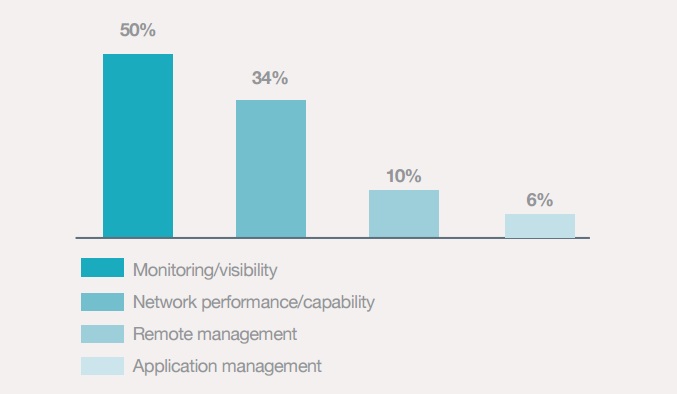
Ten percent of the responses that fell into the infrastructure category indicated that the growing demand for remote access was their biggest concern heading into the New Year, as more employees are working from home and while traveling. Finally, in this category of responses, six percent said application management was a top challenge. As the IT landscape continues to grow in complexity, this report confirmed that IT teams are in a difficult position to identify ways to do more work with less support, time and resources.

Jeff Loeb is CMO at Ipswitch.

Hot Topics

The Latest

AI is becoming the operating system of the enterprise. It acts as an invisible coordination layer that understands intent, connects systems, and executes work across complex SaaS environments. Previously, employees had to click through multiple systems — CRM, ERP, support tools, collaboration platforms — to complete a single task. Now, instead of navigating each application manually, they can simply state what they need to accomplish ...

In 2026, the cost of downtime or an outage is no longer just a technical inconvenience; it's a $600 billion wake up call for global businesses. As our digital ecosystems become  more interconnected, each touchpoint introduces new risks and multiplies the consequences when things go wrong. And the data is clear: aggregate downtime costs  for Global 2,000 companies have surged 50% since 2024, reaching a staggering $600 billion ...

Deloitte found that 74% of enterprises expect to deploy agentic AI solutions in the next 24 months. However, the rush to deployment is outpacing foundational work, though. Only 21% of enterprises have fully formed agent governance models in place. The result? AI agents deployed without guidance or governance begin to function as fragmented islands of complexity ...

Cloud spending is no longer viewed as a passthrough IT expense, but as a strategic financial lever that directly impacts innovation capacity, profitability and enterprise resilience, according to the CFO Cloud Cost Optimization Report from Azul ...

As AI moves from generating responses to performing actions, the need for trust increases exponentially. And as organizations enlist AI agents for increasingly sophisticated business processes, trust is going to be the single most important theme for spurring adoption. What can organizations do to build trustworthy AI agents? ...

I've spent a lot of time in the channel, and one thing I keep coming back to is this: a partner program is only as good as what it looks like in the field. Many programs look great on paper, but when a partner is in front of a customer navigating a complex hybrid environment or trying to make the case for AI-powered observability, the gap between what a vendor promises and what it actually delivers becomes very clear, very fast ...

Enterprises today operate in a real-time environment where uninterrupted access to trusted data has become a baseline expectation for users, applications and automated systems. Traditional DataOps models, built on manual effort and human triage, cannot keep pace with this always active demand. AI agents are emerging as the operational backbone, ensuring consistent data availability, reinforcing trustworthiness and enabling a level of scale that manual processes cannot achieve ...

For decades, trust in the digital workplace rested on familiar signals. We trusted faces on video calls, voices on the phone, and emails that appeared to come from people we knew. These cues felt human and intuitive. They anchored how decisions were made, approvals were granted, and access was authorized. AI-powered deepfakes have quietly broken that model ...

Cloud migration was supposed to be a one-way door. For most enterprises, it turns out it isn't. Cloud data repatriation is a real and growing trend. A new survey ... finds that 89% of organizations plan to expand their on-premises infrastructure footprint over the next two years — and 75% have already moved at least some workloads back from public cloud in the past 24 months. The findings point to a broad rethinking of where data belongs ...

Over the past few years, large language models (LLMs) have revolutionized the software industry. Given their ability to excel at multi-step reasoning, LLMs have helped enterprises streamline workflows and adapt to the unknown. However, employing such models comes with sky-high costs, latency issues, and limited flexibility. In the realm of IT operations, it is generally wiser to employ smaller, domain-specific models instead ...

IT Teams Name Network and Application Monitoring a Top Challenge for 2016

Jeff Loeb

All companies rely on having a fast and efficient network. Ensuring optimal network performance is no easy feat for IT teams that are tasked with keeping networks running efficiently and effectively around the clock. A new report from Ipswitch proved that this is a major concern for IT teams coping with increasing complexity – when asked what their top challenge would be in 2016, IT infrastructure and application performance monitoring was the second-leading response.

For this report, Ipswitch polled 2,685 IT professionals to determine the top IT concerns for 2016. The responses, which represented IT pros from all regions of the globe, were analyzed and categorized into eight distinct topic areas. The leading issue was security (25 percent), followed IT infrastructure and application performance monitoring (19 percent) and new technology, updates and deployment (14 percent).

Within the infrastructure category, visibility into the entire infrastructure including systems, MS apps, network, virtual environments, web servers, HTML certificates, etc. was seen as the largest concern for 50 percent of IT teams. General networking performance concerns was the second-leading response getter at 34 percent, including everything from sluggish performance to the capability of the network to handle increasingly complex workloads.

Ten percent of the responses that fell into the infrastructure category indicated that the growing demand for remote access was their biggest concern heading into the New Year, as more employees are working from home and while traveling. Finally, in this category of responses, six percent said application management was a top challenge. As the IT landscape continues to grow in complexity, this report confirmed that IT teams are in a difficult position to identify ways to do more work with less support, time and resources.

Jeff Loeb is CMO at Ipswitch.

Hot Topics

The Latest

AI is becoming the operating system of the enterprise. It acts as an invisible coordination layer that understands intent, connects systems, and executes work across complex SaaS environments. Previously, employees had to click through multiple systems — CRM, ERP, support tools, collaboration platforms — to complete a single task. Now, instead of navigating each application manually, they can simply state what they need to accomplish ...

In 2026, the cost of downtime or an outage is no longer just a technical inconvenience; it's a $600 billion wake up call for global businesses. As our digital ecosystems become  more interconnected, each touchpoint introduces new risks and multiplies the consequences when things go wrong. And the data is clear: aggregate downtime costs  for Global 2,000 companies have surged 50% since 2024, reaching a staggering $600 billion ...

Deloitte found that 74% of enterprises expect to deploy agentic AI solutions in the next 24 months. However, the rush to deployment is outpacing foundational work, though. Only 21% of enterprises have fully formed agent governance models in place. The result? AI agents deployed without guidance or governance begin to function as fragmented islands of complexity ...

Cloud spending is no longer viewed as a passthrough IT expense, but as a strategic financial lever that directly impacts innovation capacity, profitability and enterprise resilience, according to the CFO Cloud Cost Optimization Report from Azul ...

As AI moves from generating responses to performing actions, the need for trust increases exponentially. And as organizations enlist AI agents for increasingly sophisticated business processes, trust is going to be the single most important theme for spurring adoption. What can organizations do to build trustworthy AI agents? ...

I've spent a lot of time in the channel, and one thing I keep coming back to is this: a partner program is only as good as what it looks like in the field. Many programs look great on paper, but when a partner is in front of a customer navigating a complex hybrid environment or trying to make the case for AI-powered observability, the gap between what a vendor promises and what it actually delivers becomes very clear, very fast ...

Enterprises today operate in a real-time environment where uninterrupted access to trusted data has become a baseline expectation for users, applications and automated systems. Traditional DataOps models, built on manual effort and human triage, cannot keep pace with this always active demand. AI agents are emerging as the operational backbone, ensuring consistent data availability, reinforcing trustworthiness and enabling a level of scale that manual processes cannot achieve ...

For decades, trust in the digital workplace rested on familiar signals. We trusted faces on video calls, voices on the phone, and emails that appeared to come from people we knew. These cues felt human and intuitive. They anchored how decisions were made, approvals were granted, and access was authorized. AI-powered deepfakes have quietly broken that model ...

Cloud migration was supposed to be a one-way door. For most enterprises, it turns out it isn't. Cloud data repatriation is a real and growing trend. A new survey ... finds that 89% of organizations plan to expand their on-premises infrastructure footprint over the next two years — and 75% have already moved at least some workloads back from public cloud in the past 24 months. The findings point to a broad rethinking of where data belongs ...

Over the past few years, large language models (LLMs) have revolutionized the software industry. Given their ability to excel at multi-step reasoning, LLMs have helped enterprises streamline workflows and adapt to the unknown. However, employing such models comes with sky-high costs, latency issues, and limited flexibility. In the realm of IT operations, it is generally wiser to employ smaller, domain-specific models instead ...