
How Fast is Fast Enough? Consumers Expect Mobile Apps to Launch in 3 Seconds or Less

Shlomi Gian

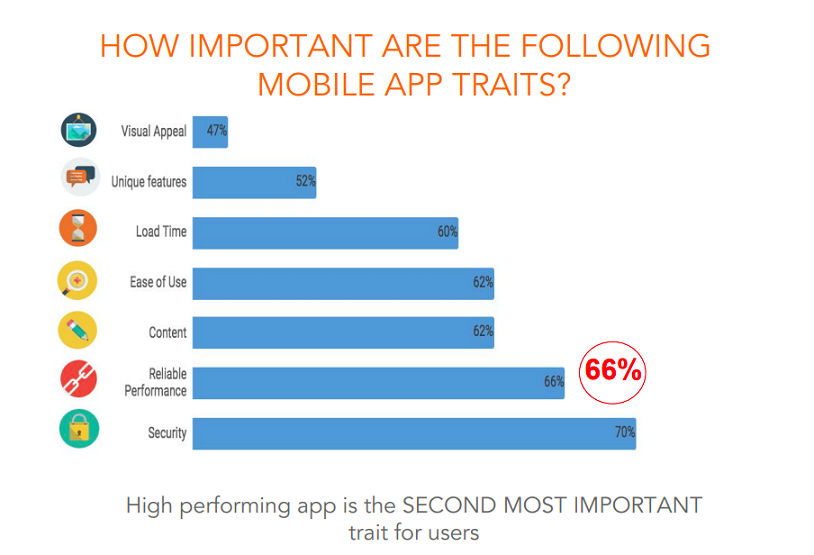
Mobile app performance is still a significant issue. The Effect of Mobile Network Performance on Mobile App Users, a study conducted by PacketZoom, showed that 66% of consumers say reliable mobile app performance is "very important" — second only to mobile app security.

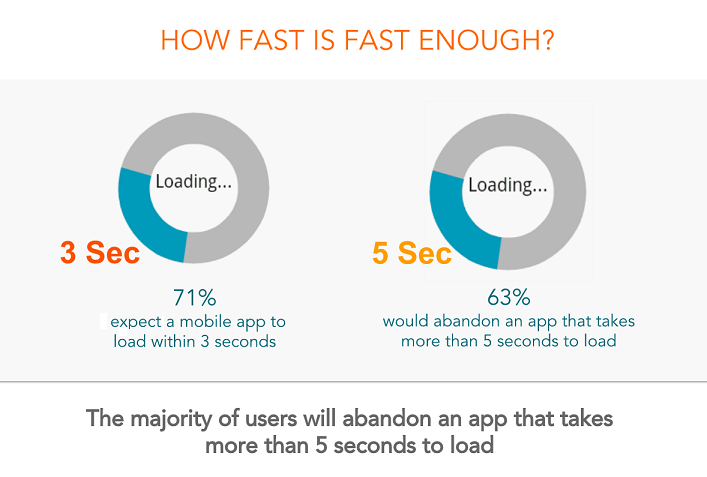
The majority of users (71%) in the study expect apps to load within three seconds and 63% abandon an app that takes more than five seconds to load.

The study also found direct correlation between mobile app performance and the brand perception. Consumers express impatience and frustration when it comes to poor performing mobile apps.

Other Study Highlights:

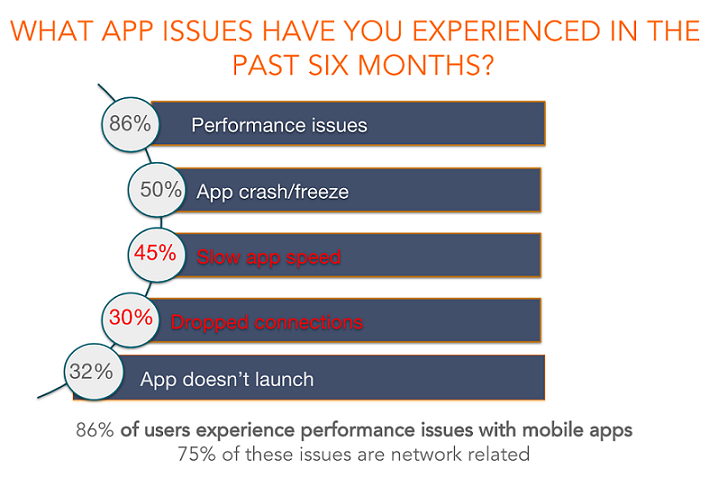
■ Most users (67%) spend time on their mobile apps while at home using wifi networks, yet 86% of users reported some mobile app performance issues in the past six months.

■ When using a poor performing mobile app: 44% of users would close the app, 34% would be less likely to use the app again and 32% would uninstall the app altogether.

■ 55% of users are likely to use a fast and reliable mobile app again; 33% are likely to use it longer (i.e., spend more time on the app) and 29% would prefer it over a competitive app.

Methdology: The study included over 2,000 mobile app users in partnership with mobile ad platform Tapjoy.

Hot Topics

The Latest

80% of respondents agree that the IT role is shifting from operators to orchestrators, according to the 2026 IT Trends Report: The Human Side of Autonomous IT from SolarWinds ...

40% of organizations deploying AI will implement dedicated AI observability tools by 2028 to monitor model performance, bias and outputs, according to Gartner ...

Until AI-powered engineering tools have live visibility of how code behaves at runtime, they cannot be trusted to autonomously ensure reliable systems, according to the State of AI-Powered Engineering Report 2026 report from Lightrun. The report reveals that a major volume of manual work is required when AI-generated code is deployed: 43% of AI-generated code requires manual debugging in production, even after passing QA or staging tests. Furthermore, an average of three manual redeploy cycles are required to verify a single AI-suggested code fix in production ...

Many organizations describe AI as strategic, but they do not manage it strategically. When AI plans are disconnected from strategy, detached from organizational learning, and protected from serious assumptions testing, the problem is no longer technical immaturity; it is a failure of management discipline ... Executives too often tell organizations to "use AI" before they define what AI is supposed to change. The problem deepens in organizations where strategy isn't well articulated in the first place ...

Across the enterprise technology landscape, a quiet crisis is playing out. Organizations have run hundreds, sometimes thousands, of generative AI pilots. Leadership has celebrated the proof of concept (POCs) ... Industry experience points to a sobering reality: only 5-10% of AI POCs that progress to the pilot stage successfully reach scaled production. The remaining 90% fail because the enterprise environment around them was never ready to absorb them, not the AI models ...

Today's modern systems are not what they once were. Organizations now rely on distributed systems, event-driven workflows, hybrid and multi-cloud environments and continuous delivery pipelines. While each adds flexibility, it also introduces new, often invisible failures. Development speed is no longer the primary bottleneck of innovation. Reliability is ...

Seeing is believing, or in this case, seeing is understanding, according to New Relic's 2025 Observability Forecast for Retail and eCommerce report. Retailers who want to provide exceptional customer experiences while improving IT operations efficiency are leaning on observability ... Here are five key takeaways from the report ...

Technology leaders across the federal landscape are facing, and will continue to face, an uphill battle when it comes to fortifying their digital environments against hostile and persistent threat actors. On one hand, they are being asked to push digital transformation ... On the other hand, they are facing the fiscal uncertainty of continuing resolutions (CR) and government shutdowns looming near and far. In the face of these challenges, CIOs, CTOs, and CISOs must figure out how to modernize legacy systems and infrastructure while doing more with less and still defending against external and internal threats ...

Reliability is no longer proven by uptime alone, according to the The SRE Report 2026 from LogicMonitor. In the AI era, it is experienced through speed, consistency, and user trust, and increasingly judged by business impact. As digital services grow more complex and AI systems move into production, traditional monitoring approaches are struggling to keep pace, increasing the need for AI-first observability that spans applications, infrastructure, and the Internet ...

If AI is the engine of a modern organization, then data engineering is the road system beneath it. You can build the most powerful engine in the world, but without paved roads, traffic signals, and bridges that can support its weight, it will stall. In many enterprises, the engine is ready. The roads are not ...

How Fast is Fast Enough? Consumers Expect Mobile Apps to Launch in 3 Seconds or Less

Shlomi Gian

Mobile app performance is still a significant issue. The Effect of Mobile Network Performance on Mobile App Users, a study conducted by PacketZoom, showed that 66% of consumers say reliable mobile app performance is "very important" — second only to mobile app security.


The majority of users (71%) in the study expect apps to load within three seconds and 63% abandon an app that takes more than five seconds to load.


The study also found direct correlation between mobile app performance and the brand perception. Consumers express impatience and frustration when it comes to poor performing mobile apps.


Other Study Highlights:

■ Most users (67%) spend time on their mobile apps while at home using wifi networks, yet 86% of users reported some mobile app performance issues in the past six months.

■ When using a poor performing mobile app: 44% of users would close the app, 34% would be less likely to use the app again and 32% would uninstall the app altogether.

■ 55% of users are likely to use a fast and reliable mobile app again; 33% are likely to use it longer (i.e., spend more time on the app) and 29% would prefer it over a competitive app.

Methdology: The study included over 2,000 mobile app users in partnership with mobile ad platform Tapjoy.

Hot Topics

The Latest

80% of respondents agree that the IT role is shifting from operators to orchestrators, according to the 2026 IT Trends Report: The Human Side of Autonomous IT from SolarWinds ...

40% of organizations deploying AI will implement dedicated AI observability tools by 2028 to monitor model performance, bias and outputs, according to Gartner ...

Until AI-powered engineering tools have live visibility of how code behaves at runtime, they cannot be trusted to autonomously ensure reliable systems, according to the State of AI-Powered Engineering Report 2026 report from Lightrun. The report reveals that a major volume of manual work is required when AI-generated code is deployed: 43% of AI-generated code requires manual debugging in production, even after passing QA or staging tests. Furthermore, an average of three manual redeploy cycles are required to verify a single AI-suggested code fix in production ...

Many organizations describe AI as strategic, but they do not manage it strategically. When AI plans are disconnected from strategy, detached from organizational learning, and protected from serious assumptions testing, the problem is no longer technical immaturity; it is a failure of management discipline ... Executives too often tell organizations to "use AI" before they define what AI is supposed to change. The problem deepens in organizations where strategy isn't well articulated in the first place ...

Across the enterprise technology landscape, a quiet crisis is playing out. Organizations have run hundreds, sometimes thousands, of generative AI pilots. Leadership has celebrated the proof of concept (POCs) ... Industry experience points to a sobering reality: only 5-10% of AI POCs that progress to the pilot stage successfully reach scaled production. The remaining 90% fail because the enterprise environment around them was never ready to absorb them, not the AI models ...

Today's modern systems are not what they once were. Organizations now rely on distributed systems, event-driven workflows, hybrid and multi-cloud environments and continuous delivery pipelines. While each adds flexibility, it also introduces new, often invisible failures. Development speed is no longer the primary bottleneck of innovation. Reliability is ...

Seeing is believing, or in this case, seeing is understanding, according to New Relic's 2025 Observability Forecast for Retail and eCommerce report. Retailers who want to provide exceptional customer experiences while improving IT operations efficiency are leaning on observability ... Here are five key takeaways from the report ...

Technology leaders across the federal landscape are facing, and will continue to face, an uphill battle when it comes to fortifying their digital environments against hostile and persistent threat actors. On one hand, they are being asked to push digital transformation ... On the other hand, they are facing the fiscal uncertainty of continuing resolutions (CR) and government shutdowns looming near and far. In the face of these challenges, CIOs, CTOs, and CISOs must figure out how to modernize legacy systems and infrastructure while doing more with less and still defending against external and internal threats ...

Reliability is no longer proven by uptime alone, according to the The SRE Report 2026 from LogicMonitor. In the AI era, it is experienced through speed, consistency, and user trust, and increasingly judged by business impact. As digital services grow more complex and AI systems move into production, traditional monitoring approaches are struggling to keep pace, increasing the need for AI-first observability that spans applications, infrastructure, and the Internet ...

If AI is the engine of a modern organization, then data engineering is the road system beneath it. You can build the most powerful engine in the world, but without paved roads, traffic signals, and bridges that can support its weight, it will stall. In many enterprises, the engine is ready. The roads are not ...