
Mobile Broadband Performance Expectations Higher Than Ever

John Reister

The importance of mobile Internet performance for smartphone owners is increasing, with expectations at an all-time high, according to Vasona Network’s annual survey of smartphone owners.

At the same time, there is a trend of gradually increasing satisfaction with the performance of mobile data services, and more consumers are inclined to recommend their provider. While perception of mobile data performance improves, simultaneous trends of data plan upgrades point to constantly moving targets for wireless carriers to continue meeting expectations.

According to the survey:

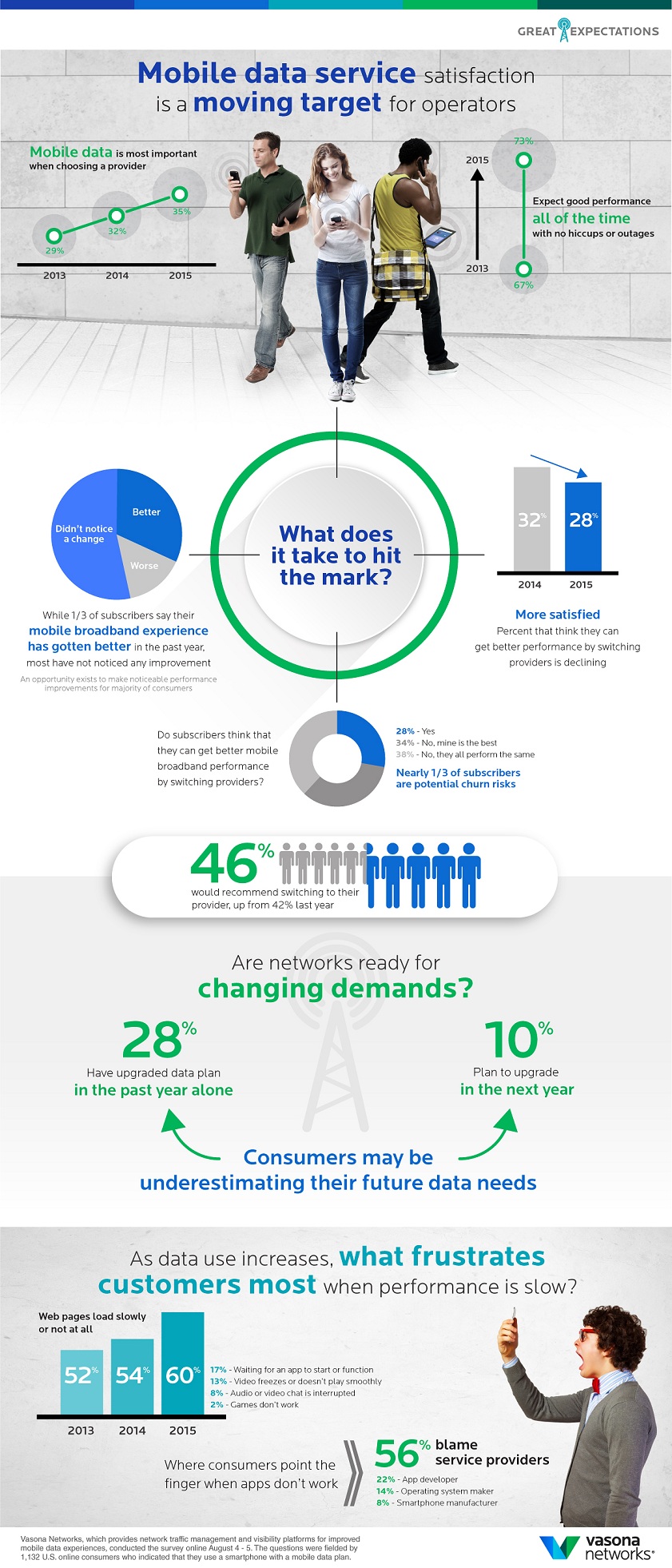
■ The importance of mobile Internet performance when choosing a service provider rose again from 32% in 2014 to 35% this year

■ Users expecting “good mobile data performance all of the time, with no temporary hiccups or outages” remains high at 73% versus 72% last year

■ 32% of smartphone owners have upgraded their mobile data plans during the past year, with an additional 10% planning to do so within the next year.

While the importance of mobile Internet performance to smartphone owners continues rising, survey results indicate more satisfaction along these lines:

■ 35% of respondents believe that their provider offers the best mobile broadband performance available, up from 31% last year

■ 46% would recommend switching to their provider, up from 42% last year

■ 28% now think that they can get better performance by switching, down from 32% last year

■ 32% say that the mobile broadband experience offered by their provider has gotten better during the past year, while only 15% think that it has gotten worse

Mobile operators have made good headway in efforts to deliver solid data experiences. This positive trend is notable, but with one third of smartphone owners recently upgrading plans and more planning to do so soon, it remains important that carriers innovate with technologies that are responsive to rising demand and able to efficiently utilize available spectrum.

Additional findings from the survey suggest that operators should focus on improving mobile browsing performance. A majority of respondents (60%) say that “web pages loading slowly or not at all” is the single most frustrating experience when networks are slow. This is up from 54% last year. And when apps don’t work, operators still get the most blame at 56%, which is more than app makers, device manufacturers or OS developers combined.

John Reister is VP of Marketing and Product Management for Vasona Networks.

Hot Topics

The Latest

Most organizations approach OpenTelemetry as a collection of individual tools they need to assemble from scratch. This view misses the bigger picture. OpenTelemetry is a complete telemetry framework with composable components that address specific problems at different stages of organizational maturity. You start with what you need today and adopt additional pieces as your observability practices evolve ...

One of the earliest lessons I learned from architecting throughput-heavy services is that simplicity wins repeatedly: fewer moving parts, loosely coupled execution (fewer synchronous calls), and precise timing metering. You want data and decisions to travel the shortest possible path. The goal is to build a system where every strategy and each line of code (contention is the key metric) complements the decision trees ...

As discussions around AI "autonomous coworkers" accelerate, many industry projections assume that agents will soon operate alongside human staff in making decisions, taking actions, and managing tasks with minimal oversight. But a growing number of critics (including some of the developers building these systems) argue that the industry still has a long way to go to be able to treat AI agents like fully trusted teammates ...

Enterprise AI has entered a transformational phase where, according to Digitate's recently released survey, Agentic AI and the Future of Enterprise IT, companies are moving beyond traditional automation toward Agentic AI systems designed to reason, adapt, and collaborate alongside human teams ...

The numbers back this urgency up. A recent Zapier survey shows that 92% of enterprises now treat AI as a top priority. Leaders want it, and teams are clamoring for it. But if you look closer at the operations of these companies, you see a different picture. The rollout is slow. The results are often delayed. There's a disconnect between what leaders want and what their technical infrastructure can handle ...

Kyndryl's 2025 Readiness Report revealed that 61% of global business and technology leaders report increasing pressure from boards and regulators to prove AI's ROI. As the technology evolves and expectations continue to rise, leaders are compelled to generate and prove impact before scaling further. This will lead to a decisive turning point in 2026 ...

Cloudflare's disruption illustrates how quickly a single provider's issue cascades into widespread exposure. Many organizations don't fully realize how tightly their systems are coupled to thirdparty services, or how quickly availability and security concerns align when those services falter ... You can't avoid these dependencies, but you can understand them ...

If you work with AI, you know this story. A model performs during testing, looks great in early reviews, works perfectly in production and then slowly loses relevance after operating for a while. Everything on the surface looks perfect — pipelines are running, predictions or recommendations are error-free, data quality checks show green; yet outcomes don't meet the ground reality. This pattern often repeats across enterprise AI programs. Take for example, a mid-sized retail banking and wealth-management firm with heavy investments in AI-powered risk analytics, fraud detection and personalized credit-decisioning systems. The model worked well for a while, but transactions increased, so did false positives by 18% ...

Basic uptime is no longer the gold standard. By 2026, network monitoring must do more than report status, it must explain performance in a hybrid-first world. Networks are no longer just static support systems; they are agile, distributed architectures that sit at the very heart of the customer experience and the business outcomes ... The following five trends represent the new standard for network health, providing a blueprint for teams to move from reactive troubleshooting to a proactive, integrated future ...

APMdigest's Predictions Series concludes with 2026 AI Predictions — industry experts offer predictions on how AI and related technologies will evolve and impact business in 2026. Part 5, the final installment, covers AI's impacts on IT teams ...

Mobile Broadband Performance Expectations Higher Than Ever

John Reister

The importance of mobile Internet performance for smartphone owners is increasing, with expectations at an all-time high, according to Vasona Network’s annual survey of smartphone owners.

At the same time, there is a trend of gradually increasing satisfaction with the performance of mobile data services, and more consumers are inclined to recommend their provider. While perception of mobile data performance improves, simultaneous trends of data plan upgrades point to constantly moving targets for wireless carriers to continue meeting expectations.

According to the survey:

■ The importance of mobile Internet performance when choosing a service provider rose again from 32% in 2014 to 35% this year

■ Users expecting “good mobile data performance all of the time, with no temporary hiccups or outages” remains high at 73% versus 72% last year

■ 32% of smartphone owners have upgraded their mobile data plans during the past year, with an additional 10% planning to do so within the next year.

While the importance of mobile Internet performance to smartphone owners continues rising, survey results indicate more satisfaction along these lines:

■ 35% of respondents believe that their provider offers the best mobile broadband performance available, up from 31% last year

■ 46% would recommend switching to their provider, up from 42% last year

■ 28% now think that they can get better performance by switching, down from 32% last year

■ 32% say that the mobile broadband experience offered by their provider has gotten better during the past year, while only 15% think that it has gotten worse

Mobile operators have made good headway in efforts to deliver solid data experiences. This positive trend is notable, but with one third of smartphone owners recently upgrading plans and more planning to do so soon, it remains important that carriers innovate with technologies that are responsive to rising demand and able to efficiently utilize available spectrum.

Additional findings from the survey suggest that operators should focus on improving mobile browsing performance. A majority of respondents (60%) say that “web pages loading slowly or not at all” is the single most frustrating experience when networks are slow. This is up from 54% last year. And when apps don’t work, operators still get the most blame at 56%, which is more than app makers, device manufacturers or OS developers combined.

John Reister is VP of Marketing and Product Management for Vasona Networks.


Hot Topics

The Latest

Most organizations approach OpenTelemetry as a collection of individual tools they need to assemble from scratch. This view misses the bigger picture. OpenTelemetry is a complete telemetry framework with composable components that address specific problems at different stages of organizational maturity. You start with what you need today and adopt additional pieces as your observability practices evolve ...

One of the earliest lessons I learned from architecting throughput-heavy services is that simplicity wins repeatedly: fewer moving parts, loosely coupled execution (fewer synchronous calls), and precise timing metering. You want data and decisions to travel the shortest possible path. The goal is to build a system where every strategy and each line of code (contention is the key metric) complements the decision trees ...

As discussions around AI "autonomous coworkers" accelerate, many industry projections assume that agents will soon operate alongside human staff in making decisions, taking actions, and managing tasks with minimal oversight. But a growing number of critics (including some of the developers building these systems) argue that the industry still has a long way to go to be able to treat AI agents like fully trusted teammates ...

Enterprise AI has entered a transformational phase where, according to Digitate's recently released survey, Agentic AI and the Future of Enterprise IT, companies are moving beyond traditional automation toward Agentic AI systems designed to reason, adapt, and collaborate alongside human teams ...

The numbers back this urgency up. A recent Zapier survey shows that 92% of enterprises now treat AI as a top priority. Leaders want it, and teams are clamoring for it. But if you look closer at the operations of these companies, you see a different picture. The rollout is slow. The results are often delayed. There's a disconnect between what leaders want and what their technical infrastructure can handle ...

Kyndryl's 2025 Readiness Report revealed that 61% of global business and technology leaders report increasing pressure from boards and regulators to prove AI's ROI. As the technology evolves and expectations continue to rise, leaders are compelled to generate and prove impact before scaling further. This will lead to a decisive turning point in 2026 ...

Cloudflare's disruption illustrates how quickly a single provider's issue cascades into widespread exposure. Many organizations don't fully realize how tightly their systems are coupled to thirdparty services, or how quickly availability and security concerns align when those services falter ... You can't avoid these dependencies, but you can understand them ...

If you work with AI, you know this story. A model performs during testing, looks great in early reviews, works perfectly in production and then slowly loses relevance after operating for a while. Everything on the surface looks perfect — pipelines are running, predictions or recommendations are error-free, data quality checks show green; yet outcomes don't meet the ground reality. This pattern often repeats across enterprise AI programs. Take for example, a mid-sized retail banking and wealth-management firm with heavy investments in AI-powered risk analytics, fraud detection and personalized credit-decisioning systems. The model worked well for a while, but transactions increased, so did false positives by 18% ...

Basic uptime is no longer the gold standard. By 2026, network monitoring must do more than report status, it must explain performance in a hybrid-first world. Networks are no longer just static support systems; they are agile, distributed architectures that sit at the very heart of the customer experience and the business outcomes ... The following five trends represent the new standard for network health, providing a blueprint for teams to move from reactive troubleshooting to a proactive, integrated future ...

APMdigest's Predictions Series concludes with 2026 AI Predictions — industry experts offer predictions on how AI and related technologies will evolve and impact business in 2026. Part 5, the final installment, covers AI's impacts on IT teams ...