

Mobile Workforce Drives Greater Need for Visibility

Donna Parent

The biggest cause of frustration when addressing workforce productivity issues is determining the source of a performance issue, according to Aternity's 2016 Business Transformation & User Experience Trends Survey.

Additionally, survey respondents said up to 90 percent of the time spent addressing an end user’s complaint is consumed trying to figure out what the issue is rather than solving it or preventing it.

More than 200 C-level executives, IT directors and IT managers shared their insights about what they believe are the driving forces behind current business transformation initiatives.

Here are four more of the top survey findings:

1. More than 95 percent of respondents said End User Computing and IT convergence are driving the need for better end user (workforce) visibility, followed closely by mobile and cloud management.

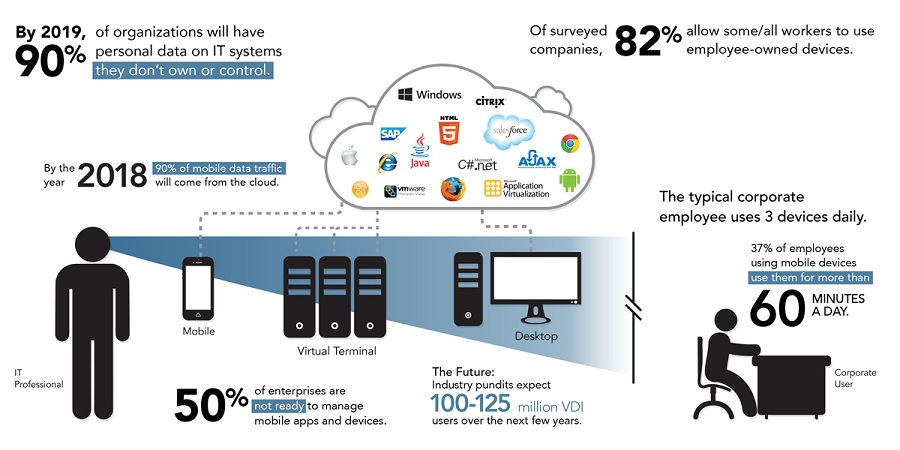
2. 62 percent said enabling a mobile workforce in 2016 is a business critical initiative, compounding the need for greater workforce visibility. See infographic below demonstrating the impact IT convergence has on the end user.

3. The primary factor driving the need to improve visibility within an organization is to gain a holistic view of the customer experience.

4. The majority of survey respondents said if they could improve their current monitoring toolset in 2016, they would opt to improve their EUEM capabilities.
Donna Parent is Vice President, Marketing at Aternity.

The Latest

In APMdigest's 2026 Observability Predictions Series, industry experts offer predictions on how Observability and related technologies will evolve and impact business in 2025. Part 3 covers more predictions about Observability ...

In APMdigest's 2026 Observability Predictions Series, industry experts offer predictions on how Observability and related technologies will evolve and impact business in 2025. Part 2 covers predictions about Observability and AIOps ...

The Holiday Season means it is time for APMdigest's annual list of predictions, covering Observability and other IT performance topics. Industry experts — from analysts and consultants to the top vendors — offer thoughtful, insightful, and often controversial predictions on how Observability, AIOps, APM and related technologies will evolve and impact business in 2026 ...

IT organizations are preparing for 2026 with increased expectations around modernization, cloud maturity, and data readiness. At the same time, many teams continue to operate with limited staffing and are trying to maintain complex environments with small internal groups. These conditions are creating a distinct set of priorities for the year ahead. The DataStrike 2026 Data Infrastructure Survey Report, based on responses from nearly 280 IT leaders across industries, points to five trends that are shaping data infrastructure planning for 2026 ...

Developers building AI applications are not just looking for fault patterns after deployment; they must detect issues quickly during development and have the ability to prevent issues after going live. Unfortunately, traditional observability tools can no longer meet the needs of AI-driven enterprise application development. AI-powered detection and auto-remediation tools designed to keep pace with rapid development are now emerging to proactively manage performance and prevent downtime ...

Every few years, the cybersecurity industry adopts a new buzzword. "Zero Trust" has endured longer than most — and for good reason. Its promise is simple: trust nothing by default, verify everything continuously. Yet many organizations still hesitate to implement Zero Trust Network Access (ZTNA). The problem isn't that ZTNA doesn't work. It's that it's often misunderstood ...

For many retail brands, peak season is the annual stress test of their digital infrastructure. It's also when often technical dashboards glow green, yet customer feedback, digital experience frustration, and conversion trends tell a different story entirely. Over the past several years, we've seen the same pattern across retail, financial services, travel, and media: internal application performance metrics fail to capture the true experience of users connecting over local broadband, mobile carriers, and congested networks using multiple devices across geographies ...

PostgreSQL promises greater flexibility, performance, and cost savings compared to proprietary alternatives. But successfully deploying it isn't always straightforward, and there are some hidden traps along the way that even seasoned IT leaders can stumble into. In this blog, I'll highlight five of the most common pitfalls with PostgreSQL deployment and offer guidance on how to avoid them, along with the best path forward ...

The rise of hybrid cloud environments, the explosion of IoT devices, the proliferation of remote work, and advanced cyber threats have created a monitoring challenge that traditional approaches simply cannot meet. IT teams find themselves drowning in a sea of data, struggling to identify critical threats amidst a deluge of alerts, and often reacting to incidents long after they've begun. This is where AI and ML are leveraged ...

Three practices, chaos testing, incident retrospectives, and AIOps-driven monitoring, are transforming platform teams from reactive responders into proactive builders of resilient, self-healing systems. The evolution is not just technical; it's cultural. The modern platform engineer isn't just maintaining infrastructure. They're product owners designing for reliability, observability, and continuous improvement ...

Mobile Workforce Drives Greater Need for Visibility

Donna Parent

The biggest cause of frustration when addressing workforce productivity issues is determining the source of a performance issue, according to Aternity's 2016 Business Transformation & User Experience Trends Survey.

Additionally, survey respondents said up to 90 percent of the time spent addressing an end user’s complaint is consumed trying to figure out what the issue is rather than solving it or preventing it.

More than 200 C-level executives, IT directors and IT managers shared their insights about what they believe are the driving forces behind current business transformation initiatives.

Here are four more of the top survey findings:

1. More than 95 percent of respondents said End User Computing and IT convergence are driving the need for better end user (workforce) visibility, followed closely by mobile and cloud management.

2. 62 percent said enabling a mobile workforce in 2016 is a business critical initiative, compounding the need for greater workforce visibility. See infographic below demonstrating the impact IT convergence has on the end user.

3. The primary factor driving the need to improve visibility within an organization is to gain a holistic view of the customer experience.

4. The majority of survey respondents said if they could improve their current monitoring toolset in 2016, they would opt to improve their EUEM capabilities.

Donna Parent is Vice President, Marketing at Aternity.

The Latest

In APMdigest's 2026 Observability Predictions Series, industry experts offer predictions on how Observability and related technologies will evolve and impact business in 2025. Part 3 covers more predictions about Observability ...

In APMdigest's 2026 Observability Predictions Series, industry experts offer predictions on how Observability and related technologies will evolve and impact business in 2025. Part 2 covers predictions about Observability and AIOps ...

The Holiday Season means it is time for APMdigest's annual list of predictions, covering Observability and other IT performance topics. Industry experts — from analysts and consultants to the top vendors — offer thoughtful, insightful, and often controversial predictions on how Observability, AIOps, APM and related technologies will evolve and impact business in 2026 ...

IT organizations are preparing for 2026 with increased expectations around modernization, cloud maturity, and data readiness. At the same time, many teams continue to operate with limited staffing and are trying to maintain complex environments with small internal groups. These conditions are creating a distinct set of priorities for the year ahead. The DataStrike 2026 Data Infrastructure Survey Report, based on responses from nearly 280 IT leaders across industries, points to five trends that are shaping data infrastructure planning for 2026 ...

Developers building AI applications are not just looking for fault patterns after deployment; they must detect issues quickly during development and have the ability to prevent issues after going live. Unfortunately, traditional observability tools can no longer meet the needs of AI-driven enterprise application development. AI-powered detection and auto-remediation tools designed to keep pace with rapid development are now emerging to proactively manage performance and prevent downtime ...

Every few years, the cybersecurity industry adopts a new buzzword. "Zero Trust" has endured longer than most — and for good reason. Its promise is simple: trust nothing by default, verify everything continuously. Yet many organizations still hesitate to implement Zero Trust Network Access (ZTNA). The problem isn't that ZTNA doesn't work. It's that it's often misunderstood ...

For many retail brands, peak season is the annual stress test of their digital infrastructure. It's also when often technical dashboards glow green, yet customer feedback, digital experience frustration, and conversion trends tell a different story entirely. Over the past several years, we've seen the same pattern across retail, financial services, travel, and media: internal application performance metrics fail to capture the true experience of users connecting over local broadband, mobile carriers, and congested networks using multiple devices across geographies ...

PostgreSQL promises greater flexibility, performance, and cost savings compared to proprietary alternatives. But successfully deploying it isn't always straightforward, and there are some hidden traps along the way that even seasoned IT leaders can stumble into. In this blog, I'll highlight five of the most common pitfalls with PostgreSQL deployment and offer guidance on how to avoid them, along with the best path forward ...

The rise of hybrid cloud environments, the explosion of IoT devices, the proliferation of remote work, and advanced cyber threats have created a monitoring challenge that traditional approaches simply cannot meet. IT teams find themselves drowning in a sea of data, struggling to identify critical threats amidst a deluge of alerts, and often reacting to incidents long after they've begun. This is where AI and ML are leveraged ...

Three practices, chaos testing, incident retrospectives, and AIOps-driven monitoring, are transforming platform teams from reactive responders into proactive builders of resilient, self-healing systems. The evolution is not just technical; it's cultural. The modern platform engineer isn't just maintaining infrastructure. They're product owners designing for reliability, observability, and continuous improvement ...