
NetOps/NPM

Services firms are grappling with significant new networking and security challenges as they increasingly transition towards digital-first operations, according to The State of Network Security in Business and Professional Services, a report commissioned by Aryaka ...

The line between work and life is blurring faster than ever. A recent Microsoft study revealed that 40% of employees check emails before 6 a.m., and evening meetings have risen by 16% since the shift to remote work began. The result? A new phenomenon many are calling the "infinite workday." While the psychological toll of this always-on culture has rightfully received attention, there's another, often-overlooked dimension: its impact on IT performance, digital access, and user experience ...

In MEAN TIME TO INSIGHT Episode 17, Shamus McGillicuddy, VP of Research, Network Infrastructure and Operations, at EMA discusses cloud network observability ... 

Reliance on packet capture to improve mean times to detection (MTTD) and resolution (MTTR) is likely to increase in 79% of enterprise organizations this year, according to the 2025/2026 State of the Network study by VIAVI Solutions ... The study shows that organizations with strong packet capture experienced notable improvements to MTTD, with double the number of respondents reporting a significantly shorter MTTD rate over the past year compared to those lacking strong packet capture capability ...

In MEAN TIME TO INSIGHT Episode 16, Shamus McGillicuddy, VP of Research, Network Infrastructure and Operations, at EMA discusses Do-It-Yourself Network Automation challenges and what vendors can do to help ... 

Kubernetes is designed for flexibility, not simplicity. Enterprises now routinely run multiple Kubernetes distributions — EKS for one team, OpenShift for another, and GKE for a third. These are typically adopted organically, often bottom-up by individual teams. The result is tooling sprawl, operational inconsistency, and a growing burden on platform teams responsible for ensuring stability, performance, and security. Here, we'll explore the three top challenges for secure networking in Kubernetes ...

As artificial intelligence (AI) adoption gains momentum, network readiness is emerging as a critical success factor. AI workloads generate unpredictable bursts of traffic, demanding high-speed connectivity that is low latency and lossless. AI adoption will require upgrades and optimizations in data center networks and wide-area networks (WANs). This is prompting enterprise IT teams to rethink, re-architect, and upgrade their data center and WANs to support AI-driven operations ...

In MEAN TIME TO INSIGHT Episode 15, Shamus McGillicuddy, VP of Research, Network Infrastructure and Operations, at EMA discusses Do-It-Yourself Network Automation ... 

Zero-day vulnerabilities — security flaws that are exploited before developers even know they exist — pose one of the greatest risks to modern organizations. Recently, such vulnerabilities have been discovered in well-known VPN systems like Ivanti and Fortinet, highlighting just how outdated these legacy technologies have become in defending against fast-evolving cyber threats ... To protect digital assets and remote workers in today's environment, companies need more than patchwork solutions. They need architecture that is secure by design ...

64% of enterprise networking teams use internally developed software or scripts for network automation, but 61% of those teams spend six or more hours per week debugging and maintaining them, according to From Scripts to Platforms: Why Homegrown Tools Dominate Network Automation and How Vendors Can Help, my latest EMA report ...

A major architectural shift is underway across enterprise networks, according to a new global study from Cisco. As AI assistants, agents, and data-driven workloads reshape how work gets done, they're creating faster, more dynamic, more latency-sensitive, and more complex network traffic. Combined with the ubiquity of connected devices, 24/7 uptime demands, and intensifying security threats, these shifts are driving infrastructure to adapt and evolve ...

Image
Cisco

Cyber threats are growing more sophisticated every day, and at their forefront are zero-day vulnerabilities. These elusive security gaps are exploited before a fix becomes available, making them among the most dangerous threats in today's digital landscape ... This guide will explore what these vulnerabilities are, how they work, why they pose such a significant threat, and how modern organizations can stay protected ...

In MEAN TIME TO INSIGHT Episode 14, Shamus McGillicuddy, VP of Research, Network Infrastructure and Operations, at EMA discusses hybrid multi-cloud network observability... 

Telecommunications is expanding at an unprecedented pace ... But progress brings complexity. As WanAware's 2025 Telecom Observability Benchmark Report reveals, many operators are discovering that modernization requires more than physical build outs and CapEx — it also demands the tools and insights to manage, secure, and optimize this fast-growing infrastructure in real time ...

A Gartner analyst recently suggested that GenAI tools could create 25% time savings for network operational teams. Where might these time savings come from? How are GenAI tools helping NetOps teams today, and what other tasks might they take on in the future as models continue improving? In general, these savings come from automating or streamlining manual NetOps tasks ...

Amidst the threat of cyberhacks and data breaches, companies install several security measures to keep their business safely afloat. These measures aim to protect businesses, employees, and crucial data. Yet, employees perceive them as burdensome. Frustrated with complex logins, slow access, and constant security checks, workers decide to completely bypass all security set-ups ...

Image

Cloudbrink's Personal SASE services provide last-mile acceleration and reduction in latency

In MEAN TIME TO INSIGHT Episode 13, Shamus McGillicuddy, VP of Research, Network Infrastructure and Operations, at EMA discusses hybrid multi-cloud networking strategy ... 

In high-traffic environments, the sheer volume and unpredictable nature of network incidents can quickly overwhelm even the most skilled teams, hindering their ability to react swiftly and effectively, potentially impacting service availability and overall business performance. This is where closed-loop remediation comes into the picture: an IT management concept designed to address the escalating complexity of modern networks ...

In the early days of the cloud revolution, business leaders perceived cloud services as a means of sidelining IT organizations. IT was too slow, too expensive, or incapable of supporting new technologies. With a team of developers, line of business managers could deploy new applications and services in the cloud. IT has been fighting to retake control ever since. Today, IT is back in the driver's seat, according to new research by Enterprise Management Associates (EMA) ...

In today's fast-paced and increasingly complex network environments, Network Operations Centers (NOCs) are the backbone of ensuring continuous uptime, smooth service delivery, and rapid issue resolution. However, the challenges faced by NOC teams are only growing. In a recent study, 78% state network complexity has grown significantly over the last few years while 84% regularly learn about network issues from users. It is imperative we adopt a new approach to managing today's network experiences ...

Image
Broadcom

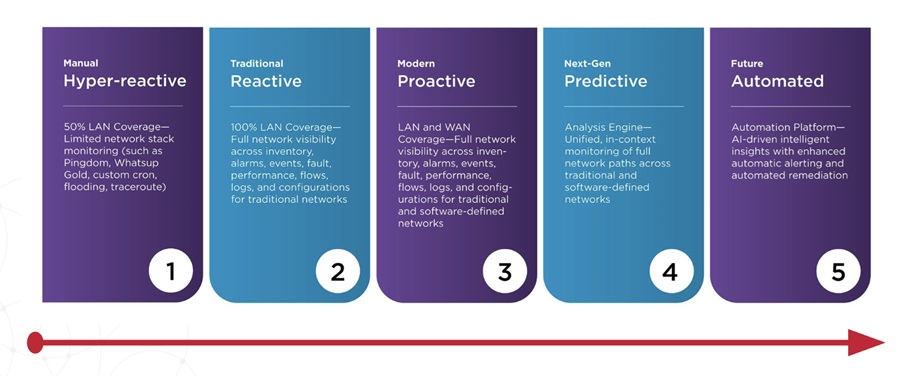
Traditional network monitoring, while valuable, often falls short in providing the context needed to truly understand network behavior. This is where observability shines. In this blog, we'll compare and contrast traditional network monitoring and observability — highlighting the benefits of this evolving approach ...

In MEAN TIME TO INSIGHT Episode 12, Shamus McGillicuddy, VP of Research, Network Infrastructure and Operations, at EMA discusses purchasing new network observability solutions.... 

IT infrastructure (on-premises, cloud, or hybrid) is becoming larger and more complex. IT management tools need data to drive better decision making and more process automation to complement manual intervention by IT staff. That is why smart organizations invest in the systems and strategies needed to make their IT infrastructure more resilient in the event of disruption, and why many are turning to application performance monitoring (APM) in conjunction with high availability (HA) clusters ...

One of the most misunderstood culprits of poor application performance is packet loss. Even minimal packet loss can cripple the throughput of a high-speed connection, making enterprise applications sluggish and frustrating for remote employee ... So, what's going wrong? And why does adding more bandwidth fail to fix the issue? ...

Image
Cloudbrink

Efficiency is a highly-desirable objective in business ... We're seeing this scenario play out in enterprises around the world as they continue to struggle with infrastructures and remote work models with an eye toward operational efficiencies. In contrast to that goal, a recent Broadcom survey of global IT and network professionals found widespread adoption of these strategies is making the network more complex and hampering observability, leading to uptime, performance and security issues. Let's look more closely at these challenges ...

Image
Broadcom

NetOps/NPM

Services firms are grappling with significant new networking and security challenges as they increasingly transition towards digital-first operations, according to The State of Network Security in Business and Professional Services, a report commissioned by Aryaka ...

The line between work and life is blurring faster than ever. A recent Microsoft study revealed that 40% of employees check emails before 6 a.m., and evening meetings have risen by 16% since the shift to remote work began. The result? A new phenomenon many are calling the "infinite workday." While the psychological toll of this always-on culture has rightfully received attention, there's another, often-overlooked dimension: its impact on IT performance, digital access, and user experience ...

In MEAN TIME TO INSIGHT Episode 17, Shamus McGillicuddy, VP of Research, Network Infrastructure and Operations, at EMA discusses cloud network observability ... 

Reliance on packet capture to improve mean times to detection (MTTD) and resolution (MTTR) is likely to increase in 79% of enterprise organizations this year, according to the 2025/2026 State of the Network study by VIAVI Solutions ... The study shows that organizations with strong packet capture experienced notable improvements to MTTD, with double the number of respondents reporting a significantly shorter MTTD rate over the past year compared to those lacking strong packet capture capability ...

In MEAN TIME TO INSIGHT Episode 16, Shamus McGillicuddy, VP of Research, Network Infrastructure and Operations, at EMA discusses Do-It-Yourself Network Automation challenges and what vendors can do to help ... 

Kubernetes is designed for flexibility, not simplicity. Enterprises now routinely run multiple Kubernetes distributions — EKS for one team, OpenShift for another, and GKE for a third. These are typically adopted organically, often bottom-up by individual teams. The result is tooling sprawl, operational inconsistency, and a growing burden on platform teams responsible for ensuring stability, performance, and security. Here, we'll explore the three top challenges for secure networking in Kubernetes ...

As artificial intelligence (AI) adoption gains momentum, network readiness is emerging as a critical success factor. AI workloads generate unpredictable bursts of traffic, demanding high-speed connectivity that is low latency and lossless. AI adoption will require upgrades and optimizations in data center networks and wide-area networks (WANs). This is prompting enterprise IT teams to rethink, re-architect, and upgrade their data center and WANs to support AI-driven operations ...

In MEAN TIME TO INSIGHT Episode 15, Shamus McGillicuddy, VP of Research, Network Infrastructure and Operations, at EMA discusses Do-It-Yourself Network Automation ... 

Zero-day vulnerabilities — security flaws that are exploited before developers even know they exist — pose one of the greatest risks to modern organizations. Recently, such vulnerabilities have been discovered in well-known VPN systems like Ivanti and Fortinet, highlighting just how outdated these legacy technologies have become in defending against fast-evolving cyber threats ... To protect digital assets and remote workers in today's environment, companies need more than patchwork solutions. They need architecture that is secure by design ...

64% of enterprise networking teams use internally developed software or scripts for network automation, but 61% of those teams spend six or more hours per week debugging and maintaining them, according to From Scripts to Platforms: Why Homegrown Tools Dominate Network Automation and How Vendors Can Help, my latest EMA report ...

A major architectural shift is underway across enterprise networks, according to a new global study from Cisco. As AI assistants, agents, and data-driven workloads reshape how work gets done, they're creating faster, more dynamic, more latency-sensitive, and more complex network traffic. Combined with the ubiquity of connected devices, 24/7 uptime demands, and intensifying security threats, these shifts are driving infrastructure to adapt and evolve ...

Image
Cisco

Cyber threats are growing more sophisticated every day, and at their forefront are zero-day vulnerabilities. These elusive security gaps are exploited before a fix becomes available, making them among the most dangerous threats in today's digital landscape ... This guide will explore what these vulnerabilities are, how they work, why they pose such a significant threat, and how modern organizations can stay protected ...

In MEAN TIME TO INSIGHT Episode 14, Shamus McGillicuddy, VP of Research, Network Infrastructure and Operations, at EMA discusses hybrid multi-cloud network observability... 

Telecommunications is expanding at an unprecedented pace ... But progress brings complexity. As WanAware's 2025 Telecom Observability Benchmark Report reveals, many operators are discovering that modernization requires more than physical build outs and CapEx — it also demands the tools and insights to manage, secure, and optimize this fast-growing infrastructure in real time ...

A Gartner analyst recently suggested that GenAI tools could create 25% time savings for network operational teams. Where might these time savings come from? How are GenAI tools helping NetOps teams today, and what other tasks might they take on in the future as models continue improving? In general, these savings come from automating or streamlining manual NetOps tasks ...

Amidst the threat of cyberhacks and data breaches, companies install several security measures to keep their business safely afloat. These measures aim to protect businesses, employees, and crucial data. Yet, employees perceive them as burdensome. Frustrated with complex logins, slow access, and constant security checks, workers decide to completely bypass all security set-ups ...

Image
Cloudbrink's Personal SASE services provide last-mile acceleration and reduction in latency

In MEAN TIME TO INSIGHT Episode 13, Shamus McGillicuddy, VP of Research, Network Infrastructure and Operations, at EMA discusses hybrid multi-cloud networking strategy ... 

In high-traffic environments, the sheer volume and unpredictable nature of network incidents can quickly overwhelm even the most skilled teams, hindering their ability to react swiftly and effectively, potentially impacting service availability and overall business performance. This is where closed-loop remediation comes into the picture: an IT management concept designed to address the escalating complexity of modern networks ...

In the early days of the cloud revolution, business leaders perceived cloud services as a means of sidelining IT organizations. IT was too slow, too expensive, or incapable of supporting new technologies. With a team of developers, line of business managers could deploy new applications and services in the cloud. IT has been fighting to retake control ever since. Today, IT is back in the driver's seat, according to new research by Enterprise Management Associates (EMA) ...

In today's fast-paced and increasingly complex network environments, Network Operations Centers (NOCs) are the backbone of ensuring continuous uptime, smooth service delivery, and rapid issue resolution. However, the challenges faced by NOC teams are only growing. In a recent study, 78% state network complexity has grown significantly over the last few years while 84% regularly learn about network issues from users. It is imperative we adopt a new approach to managing today's network experiences ...

Image
Broadcom

Traditional network monitoring, while valuable, often falls short in providing the context needed to truly understand network behavior. This is where observability shines. In this blog, we'll compare and contrast traditional network monitoring and observability — highlighting the benefits of this evolving approach ...

In MEAN TIME TO INSIGHT Episode 12, Shamus McGillicuddy, VP of Research, Network Infrastructure and Operations, at EMA discusses purchasing new network observability solutions.... 

IT infrastructure (on-premises, cloud, or hybrid) is becoming larger and more complex. IT management tools need data to drive better decision making and more process automation to complement manual intervention by IT staff. That is why smart organizations invest in the systems and strategies needed to make their IT infrastructure more resilient in the event of disruption, and why many are turning to application performance monitoring (APM) in conjunction with high availability (HA) clusters ...

One of the most misunderstood culprits of poor application performance is packet loss. Even minimal packet loss can cripple the throughput of a high-speed connection, making enterprise applications sluggish and frustrating for remote employee ... So, what's going wrong? And why does adding more bandwidth fail to fix the issue? ...

Image
Cloudbrink

Efficiency is a highly-desirable objective in business ... We're seeing this scenario play out in enterprises around the world as they continue to struggle with infrastructures and remote work models with an eye toward operational efficiencies. In contrast to that goal, a recent Broadcom survey of global IT and network professionals found widespread adoption of these strategies is making the network more complex and hampering observability, leading to uptime, performance and security issues. Let's look more closely at these challenges ...

Image
Broadcom