
Observability
Reliance on packet capture to improve mean times to detection (MTTD) and resolution (MTTR) is likely to increase in 79% of enterprise organizations this year, according to the 2025/2026 State of the Network study by VIAVI Solutions ... The study shows that organizations with strong packet capture experienced notable improvements to MTTD, with double the number of respondents reporting a significantly shorter MTTD rate over the past year compared to those lacking strong packet capture capability ...
Kubernetes is designed for flexibility, not simplicity. Enterprises now routinely run multiple Kubernetes distributions — EKS for one team, OpenShift for another, and GKE for a third. These are typically adopted organically, often bottom-up by individual teams. The result is tooling sprawl, operational inconsistency, and a growing burden on platform teams responsible for ensuring stability, performance, and security. Here, we'll explore the three top challenges for secure networking in Kubernetes ...
If you've worked in infrastructure or observability engineering for more than a few years, chances are you've been told more than once that practices like sampling, data aggregation, and short retention windows are just "best practices." The rationale is familiar: save money, reduce system strain, stay agile. But I want to challenge that framing. These aren't best practices. They're coping mechanisms. And they're costing us more than we realize ...
It's 7 in the morning. You get an alert from your team. A critical service is down. Yet, your monitoring systems show no critical alerts. Where is the problem? You are considering calling for a war room. It will be a massive distraction for the best people on your team, but what option do you have? ...
According to an analysis from 130 enterprise organizations using the BigPanda platform, the Monitoring and Observability Tool Effectiveness for IT Event Management report, the average enterprise sends 9.6 million observability events annually to the platform, but fewer than 1 in 5 are ever acted upon ...
Application performance monitoring (APM) is a game of catching up — building dashboards, setting thresholds, tuning alerts, and manually correlating metrics to root causes. In the early days, this straightforward model worked as applications were simpler, stacks more predictable, and telemetry was manageable. Today, the landscape has shifted, and more assertive tools are needed ...
Traditional observability requires users to leap across different platforms or tools for metrics, logs, or traces and related issues manually, which is very time-consuming, so as to reasonably ascertain the root cause. Observability 2.0 fixes this by unifying all telemetry data, logs, metrics, and traces into a single, context-rich pipeline that flows into one smart platform. But this is far from just having a bunch of additional data; this data is actionable, predictive, and tied to revenue realization ...
As observability engineers, we navigate a sea of telemetry daily. We instrument our applications, configure collectors, and build dashboards, all in pursuit of understanding our complex distributed systems. Yet, amidst this flood of data, a critical question often remains unspoken, or at best, answered by gut feeling: "Is our telemetry actually good?" ... We're inviting you to participate in shaping a foundational element for better observability: the Instrumentation Score ...
We're inching ever closer toward a long-held goal: technology infrastructure that is so automated that it can protect itself. But as IT leaders aggressively employ automation across our enterprises, we need to continuously reassess what AI is ready to manage autonomously and what can not yet be trusted to algorithms ...
Much like a traditional factory turns raw materials into finished products, the AI factory turns vast datasets into actionable business outcomes through advanced models, inferences, and automation. From the earliest data inputs to the final token output, this process must be reliable, repeatable, and scalable. That requires industrializing the way AI is developed, deployed, and managed ...
Two in three IT professionals now cite growing complexity as their top challenge — an urgent signal that the modernization curve may be getting too steep, according to the Rising to the Challenge survey from Checkmk ...
In MEAN TIME TO INSIGHT Episode 14, Shamus McGillicuddy, VP of Research, Network Infrastructure and Operations, at EMA discusses hybrid multi-cloud network observability...
Telecommunications is expanding at an unprecedented pace ... But progress brings complexity. As WanAware's 2025 Telecom Observability Benchmark Report reveals, many operators are discovering that modernization requires more than physical build outs and CapEx — it also demands the tools and insights to manage, secure, and optimize this fast-growing infrastructure in real time ...
Misaligned architecture can lead to business consequences, with 93% of respondents reporting negative outcomes such as service disruptions, high operational costs and security challenges ...
In March, New Relic published the State of Observability for Media and Entertainment Report to share insights, data, and analysis into the adoption and business value of observability across the media and entertainment industry. Here are six key takeaways from the report ...
IT spending is expected to jump nearly 10% in 2025, and organizations are now facing pressure to manage costs without slowing down critical functions like observability. To meet the challenge, leaders are turning to smarter, more cost effective business strategies. Enter stage right: OpenTelemetry, the missing piece of the puzzle that is no longer just an option but rather a strategic advantage ...
In high-traffic environments, the sheer volume and unpredictable nature of network incidents can quickly overwhelm even the most skilled teams, hindering their ability to react swiftly and effectively, potentially impacting service availability and overall business performance. This is where closed-loop remediation comes into the picture: an IT management concept designed to address the escalating complexity of modern networks ...
Enterprises are turning to AI-powered software platforms to make IT management more intelligent and ensure their systems and technology meet business needs for efficiency, lowers costs and innovation, according to new research from Information Services Group ...
The power of Kubernetes lies in its ability to orchestrate containerized applications with unparalleled efficiency. Yet, this power comes at a cost: the dynamic, distributed, and ephemeral nature of its architecture creates a monitoring challenge akin to tracking a constantly shifting, interconnected network of fleeting entities ... Due to the dynamic and complex nature of Kubernetes, monitoring poses a substantial challenge for DevOps and platform engineers. Here are the primary obstacles ...
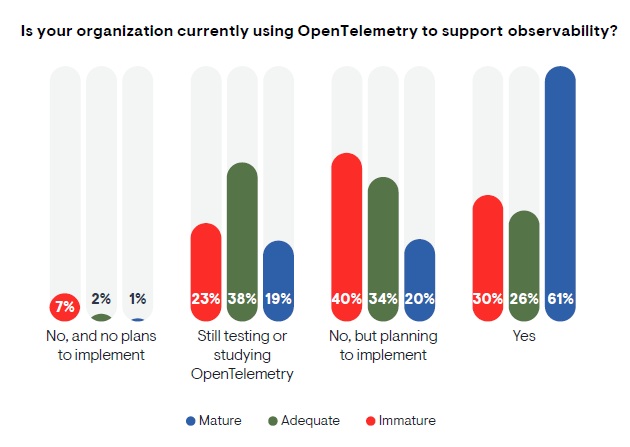
OpenTelemetry enjoys a positive perception, with half of respondents considering OpenTelemetry mature enough for implementation today, and another 31% considering it moderately mature and useful, according to a new EMA report, Taking Observability to the Next Level: OpenTelemetry's Emerging Role in IT Performance and Reliability ... and almost everyone surveyed (98.7%) expresses support for where OpenTelemetry is heading ...
Image
Open source dominance continues in observability, according to the Observability Survey from Grafana Labs. A remarkable 75% of respondents are now using open source licensing for observability, with 70% reporting that their organizations use both Prometheus and OpenTelemetry in some capacity. Half of all organizations increased their investments in both technologies for the second year in a row ...
Today's enterprises exist in rapidly growing, complex IT landscapes that can inadvertently create silos and lead to the accumulation of disparate tools. To successfully manage such growth, these organizations must realize the requisite shift in corporate culture and workflow management needed to build trust in new technologies. This is particularly true in cases where enterprises are turning to automation and autonomic IT to offload the burden from IT professionals. This interplay between technology and culture is crucial in guiding teams using AIOps and observability solutions to proactively manage operations and transition toward a machine-driven IT ecosystem ...
Traditional network monitoring, while valuable, often falls short in providing the context needed to truly understand network behavior. This is where observability shines. In this blog, we'll compare and contrast traditional network monitoring and observability — highlighting the benefits of this evolving approach ...
As applications expand and systems intertwine, performance bottlenecks, quality lapses, and disjointed pipelines threaten progress. To stay ahead, leading organizations are turning to three foundational strategies: developer-first observability, API platform adoption, and sustainable test growth ...
The surge in AI adoption amplifies the need for robust data center infrastructure to handle the terabytes of data being generated daily ... Still, as much as AI will benefit from data centers, data centers need observability solutions to ensure resiliency and sustainability so businesses can operate to their full potential and provide seamless experiences to customers ...